The U.S. oil and natural gas industry continues to drive methane reductions across the supply chain, making progress across key performance categories even as production increased, according to data released by the Environmental Partnership in their fifth annual report.
The Partnership, a voluntary initiative representing nearly 70 percent of U.S. onshore oil and gas operations, showcases the industry’s commitment to responsible operations through innovation and collaboration. Highlighting the industry’s progress, Mike Sommers, President and CEO of the American Petroleum Institute said:
“The U.S. oil and natural gas industry is continuously evolving to promote better, safer and more efficient methods for producing affordable reliable energy while reducing emissions…Tackling the challenge of reducing methane emissions requires not just words, but action…” (emphasis added)
Highlights of these actions include:
Reduced Flaring Intensity
After cutting flaring intensity nearly in half in 2021, this year’s report highlights an additional 14 percent reduction in total flare volumes and a 2.4 percent reduction in flare intensity from the previous year – even as U.S. oil and gas production grew by 5.6 percent and 4 percent, respectively.
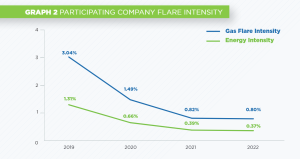
Reducing flaring not only means more natural gas is able to get to market to meet growing energy demand but also ensures a cleaner environment with less greenhouse gas emissions released into the air.
Reducing Leak Occurrence to 0.07 Percent
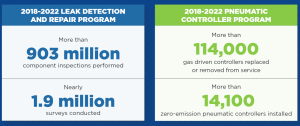
By focusing on leak detection and repairs, participating companies were able to reduce leak occurrence rates to 0.07 percent among the over 157,000 sites surveyed. The report highlights the aggressive actions companies are taking to expand their leak detection programs, including:
Innovations in this space include increased use of flyover technology using methane-specific light detection and ranging (LiDAR) instruments. As the report explains:
“Over the past two years, companies participated in flyovers in eight basins (Permian, DJ, Bakken, Marcellus, Anadarko, Eagleford, Haynesville and Powder River), and surveyed nearly 10,000 sites. In many cases, operators surveyed their more complex sites and, in each round of surveys, chose different sites, thereby providing a deeper understanding of emissions across their assets.”
Replacing Pneumatic Controllers with Low- or Zero-Emitting Devices
In 2022 alone, more than 61,700 gas driven controllers were replaced or removed while more than 4,000 zero-emission pneumatic controllers were installed at new sites, demonstrating the industry’s commitment to modernizing equipment that better serves the environment.
Additionally, according to the report, more than 700 high-bleed pneumatic controllers were replaced, retrofitted, or removed from service, with 61 participating companies no longer utilizing high-bleed pneumatic controllers in their operations entirely.
Continued Growth & Progress
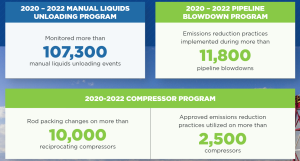
The Environmental Partnership expanded its commitment this year by adding two new liquid pipeline programs, further driving emissions mitigation across the supply chain, specifically in transmission and storage.
This year’s report also marked the five-year anniversary of the launch of the Environmental Partnership. Since its creation, the coalition has grown from just 23 companies to over 100, represents operators in 47 out of 50 states, added additional performance programs, and continues to advance its goal: to improve industry environmental performance by sharing best practices and innovations through Basin Workshops, meetings and collaboration.
Since the start of the Partnership, immense progress has been made, including:
Highlighting this growth, Vanessa Ryan, chair of The Environmental Partnership and manager of methane reduction for Chevron, said:
“After five years as chair of The Environmental Partnership, I continue to be both impressed by and grateful for our participants’ ingenuity, creativity, and know-how for solving problems, powering our lives and reducing environmental impacts.”
Bottom Line: The United States is leading the world in both reducing emissions and oil and natural gas production. In fact, U.S. operators have reduced methane emissions by 66 percent in the largest producing regions from 2011-2021, thanks in large part to leadership by the oil and natural gas industry. Voluntary coalitions like the Environmental Partnership prove that collaboration and innovation produce results, not just mandates or overregulation.