A reporter for the Guardian secretly edited their reporting to obscure revelations that the ringleaders of the “Exxon Knew” campaign are working to prepare Democrats on Congressional committees to hold a “Waxman-style” hearing like the one that investigated tobacco companies in the 1990s. This time, they want to probe energy companies over their knowledge of climate change.
Coordinated campaigns and one-sided media coverage have of the standard playbook for anti-energy activists from the beginning. Even so, it’s rarely as blatant as what played out in a recent Guardian article slamming fossil fuel companies for a new advertising campaign that focuses how the industry has worked to reduce carbon emissions. The Guardian turned to Geoffrey Supran, a leader in the fossil fuel divestment movement, and Naomi Oreskes, a Harvard professor long involved in the campaign to prosecute oil companies for alleged climate fraud, to comment.
True to character, Supran took the opportunity to bash fossil fuels and call for a major investigation of energy companies. What’s more telling is his admission of the steps he—and Oreskes—are taking to try to make this happen.
The Guardian’s story reveals that Oreskes and Supran are working intimately with the Congressional oversight committees in an attempt to use Congress to accomplish what years of lawsuits by state attorneys general could not: force energy companies to open their books in hopes of finding a scandal.
Companies, including ExxonMobil and its subsidiary Imperial Oil, have already had millions of pages of documents publicized and investigated with nary a smoking gun to be seen. Even so, Supran and other activists are convinced that a critical document outlining some grand conspiracy is yet to be found. According to Supran, obtaining these documents would be “one of the most important actions Congress could take” to address climate change.
To accomplish this, Supran and fellow activists are putting a full-court press on members of Congress, trying to get them to call official hearings to question oil and gas executives.
Supran’s plan goes beyond simply calling for a hearing. An archived version of the story in the Guardian explains that Supran “says [he and Oreskes] have a game plan that outlines which questions Democrats could ask and which documents they could demand.”
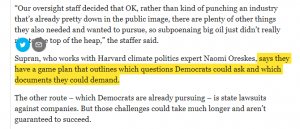
If true, this is a heavy-handed attempt to lobby Congress. Perhaps realizing this, the story has been changed since its original publication. Now it reads benignly that Supran and Oreskes “have a collection of information that could help Democrats determine which questions to ask and which documents to demand.”
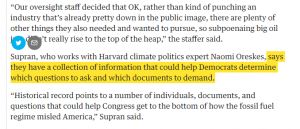
It seems evident that a media-savvy member of Supran’s circle contacted the Guardian and asked them to alter the story. What’s more shocking is that the Guardian agreed—and made the changes without including an editor’s note or other statement explaining that the text had been altered. Without this, readers have no way of knowing how the facts of the article where changed.
And that’s no small matter. This change dramatically changes the reader’s sense of what Supran and his crew are doing. Instead of spoon-feeding members of Congress questions and lists of documents to request, they are instead “gathering materials” that could be shared, if requested.
This is just more evidence of the Guardian bending over backward to support activists’ storyline. The Guardian also ran an op-ed by Supran and Oreskes that tried to link “big oil” to “big tobacco” and called for Congress to continue investigating whether energy companies knew of climate change risks and chose to suppress evidence. Now the two activists want to see more of the same:
“Our message to Congress after its first foray into investigating fossil fuels is this: keep going. Because big oil is the new big tobacco.”
That message is rather odd, since they admit in the same piece that they wouldn’t dare presume to tell Congress what, or how to investigate:
“We are not politicians or political strategists, so we do not presume to dictate how Congress exercises its investigatory powers.”
And yet, that seems to be exactly what they are doing in the same piece when they call on Congress to “request documents and, if necessary, issue subpoenas.” This strategy ties back to the infamous conference Oreskes organized at La Jolla, Calif. in 2012, where activists laid out their playbook for this campaign:
“Having attested to the importance of seeking internal documents in the legal discovery phase of tobacco cases, lawyers at the workshop emphasized that there are many effective avenues for gaining access to such documents.
“First, lawsuits are not the only way to win the release of documents. As one participant noted, congressional hearings can yield documents. In the case of tobacco, for instance, the infamous “Doubt is our product” document came out after being subpoenaed by Congress.” (emphasis added)
This sort of deceptive coverage is not a first for the Guardian. Just a few months ago, the Guardian pulled out its purple pens for a gushing series of pieces on the “Carbon Majors” report written by Richard Heede of the Climate Accountability Institute. This study had a number of major flaws and critical weaknesses—including an admission that 90 percent of fossil fuel emissions can’t be attributed to the energy companies Heede wanted to vilify.
Still, the Guardian devoted an entire series to these findings, which spanned 11 pieces of content including articles, a video, opinion columns, and a timeline. It never introduced outside voices who might have questioned the study’s findings. That sort of one-sided coverage puts the Guardian closer to the category of environmentalist advocates rather than fair-minded journalists. Sadly, that ship sailed in 2015, when the paper announced a formal partnership with 350.org for the “Keep It In The Ground” campaign.
The Guardian’s coverage is, however, in keeping with the “my way or the highway” approach Oreskes takes to media. Already this year she has publicly criticized journalistic balance and objectivity in an interview with the New Zealand Listener and called for regulations on free speech:
All previous electronic media – radio, telephone, television – have been regulated. There’s absolutely no reason why this newest form should not be regulated. And people who cry ‘free speech! free speech!’ are ignoring history.”
When EID Climate pointed out this rather extreme position, Oreskes responded without linking back to EID Climate or otherwise identifying the source of the criticism, nor did her response include her original offending statement.
Instead, Oreskes took to The Energy Mix, a blog published by a friendly Canadian climate activist NGO to lament industry groups who “plant disinformation in friendly venues.”
Pot, meet kettle?