With U.S. Supreme Court arguments in Suncor Energy Inc. v. County Commissioners of Boulder County just two days away, Colorado activists are already bracing for defeat and have spent months building a Plan B in their quest to disrupt climate policy and bankrupt America’s energy industry.
While rumors and rumblings of a superfund bill in Colorado began as early as December 2025, the stakes for the activists became real back in February when SCOTUS took up the Boulder climate lawsuit. SCOTUS opening the could deal a fatal blow to both that case and dozens of others around the country.
Now, a new report from the Daily Caller reveals that activist groups and Democratic lawmakers are moving full steam ahead with climate superfund legislation that may get introduced in early 2027 with the specific intent of dramatically overhauling the state’s climate strategy.
Rockefeller Roots
After suffering repeated defeats in courthouses across the country, the leaders of the national climate litigation campaign, some of the wealthiest and most well-connected activists in America, turned their attention to state legislatures.
Rockefeller Family Fund’s Lee Wasserman conceptualized the idea behind climate superfund legislation with a friend during a baseball game. As Wasserman recounted in Bill McKibben’s newsletter:
“The idea for the climate superfund bill was hatched when I was at Fenway watching the Red Sox with an old friend, Rob Plattner, who had been earlier in his career deputy commissioner for policy at the NYS Tax Dept.”
The proposal migrated to Washington, where Wasserman and his allies worked a federal version into the Build Back Better negotiations, where it drew support from Sens. Chris Van Hollen and Bernie Sanders before eventually fading away.
When the federal door closed, the activists shifted their attention to friendlier, deep-blue state legislatures. The strategy mirrored the broader climate litigation campaign: pursue similar claims across multiple jurisdictions, search for favorable venues and attempt to build momentum in a patchwork manner.
SCOTUS and the Switch to a Superfund in Colorado
For the Boulder lawsuit, even activists including Michael Burger, executive director of the Sabin Center for Climate Change Law at Columbia University, believed the plaintiffs’ chances at the Supreme Court would be “slim.”
Back in December 2025, Bloomberg Law reported that activists from Fossil Free Media were advocating for “climate superfund” bills across the nation, including in Colorado, to hit the energy industry with billions in retroactive taxes:
“Colorado, Illinois, Minnesota, and Washington, D.C., are all working on climate superfund bills, said Cassidy DiPaola, communications director for Fossil-Free Media’s Polluters Pay campaign, which has been pushing the legislation across states.”
The Daily Caller report pulls back the curtain and shows that the activists quickly mobilized, spending the summer touring the state to rally support for a bill in the upcoming legislative session.
From Aspen to Aurora and Denver to Durango, the activists were supported by local chapters of national activist groups, including 350 Colorado, Fossil Fuel Media, Sierra Club, Third Act Colorado, Moms Clean Air Force, Climate Reality Project, and Sunrise Denver. Democratic State Senator Cathy Kipp and Democratic State Rep. Yara Zokaie also joined along for an event in Fort Collins.
During the summer surge, the activists themselves even went as far as to call the superfund what it is: part of a larger strategy – combined with climate litigation and insurance legislation – to bankrupt the energy industry and completely overhaul how Colorado approaches climate policy.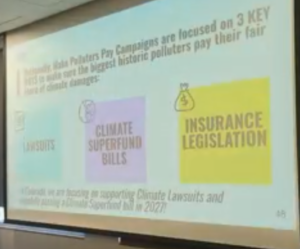
Setup for Setbacks
Despite the renewed push, the campaign for a superfund in Colorado is likely to face its own set of challenges.
A federal judge recently dealt New York’s climate superfund law a second strike, ruling that only the federal government may regulate interstate emissions and advance U.S. foreign-policy interests. The decision followed a similar August ruling from the U.S. District Court for the Northern District of New York.
Adding an additional layer of complexity, Colorado’s Taxpayer’s Bill of Rights, or TABOR, requires the explicit approval of voters for new taxes and tax increases – a massive hurdle that even State Senator Kipp said would be difficult to overcome.
Activists in Colorado will also face unpopular politics amid an electorate focused on affordability – as demonstrated with a wave of defeats of other climate superfund bills in state legislatures around the country in 2026.
Bottom Line: While a Supreme Court loss could shut down Boulder’s long-standing lawsuit and mark the beginning of the end of the decade-long climate litigation campaign, activists are not letting up. They are merely pivoting to Plan B. While the bill is set to face its own set of challenges, it shows that activists are only set to double down on their ultimate goal of taking down America’s oil and natural gas industry.