Oil and natural gas companies are rapidly deploying new breakthrough technologies and spending billions of dollars on research in development in a massive effort to lower global greenhouse gas emissions.
As the world celebrates Earth Day, these initiatives are reasons for optimism that the world will be able to meet growing energy demand while also addressing the challenge of climate change. As the Independent Petroleum Association of America President and CEO Barry Russell said:
“Together, the industry is leading the way to advance and implement new technologies to minimize our environmental impacts while we continue to provide the energy that drives our nation’s economy and way of life.”

Boosting Efficiency of Existing Operations
One of the fastest ways to decrease greenhouse gas emissions is to increase the efficiency of existing operations and reducing methane leaks and flaring is at the forefront of that effort.
To help accomplish those goals, nearly 100 oil and natural gas companies including Apache, BP, Chesapeake Energy, Chevron, EOG, ExxonMobil, Occidental, Ovintiv, Range Resources, and Shell have joined the Environmental Partnership to share innovative ideas and best practices, providing members with tools that are “designed to further reduce emissions using proven, cost-effective technologies.”
This work and other efforts have seen real results over the past decade with methane rates falling in major basins.
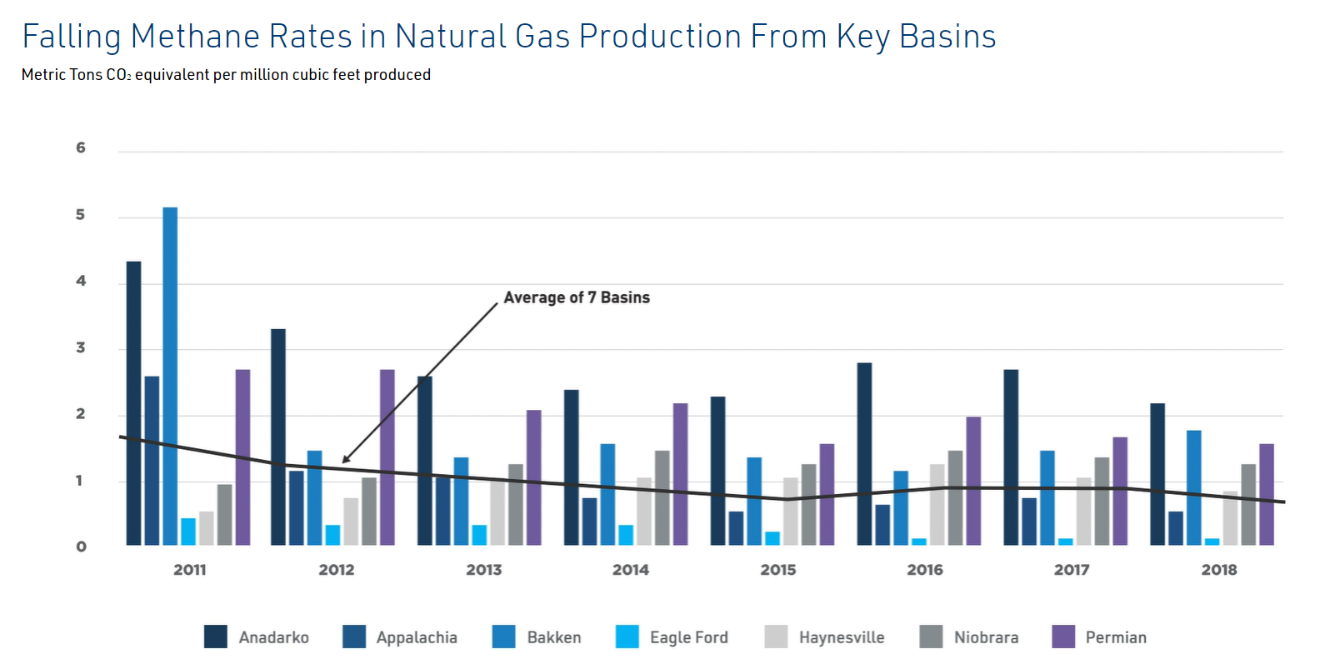
Source: American Petroleum Institute, State of American Energy 2021
Committing to Improving Operations
Oil and gas companies across the country are investing in innovation and committed to reducing emissions. For example:
- Last year, ExxonMobil launched Project Astra in collaboration with the University of Texas at Austin, Environmental Defense Fund, Gas Technology Institute and Pioneer Natural Resources to deploy state of the art sensors in the Permian to help locate and fix methane leaks.
- Also in 2020, Occidental joined BP and Shell in signing onto the World Bank’s Zero Flaring by 2030 initiative, which aims to phase out the routine use of flaring by the end of the decade. And this past weekend, BP announced a plan to spend $1.3 billion to build the necessary infrastructure in the Permian Basin to help meet that goal.
- Chevron and ExxonMobil have also laid out plans to reduce the methane emissions intensity of their operations by 25 percent by 2030 and 40 percent by 2050, respectively.
- EOG Resources, which has major operations in the Permian, recently set a goal to stop routine flaring in the next five years and achieve net zero scope 1 and 2 emissions by 2040.
- Ovintiv, a large operator with assets in major basins in the United States and Canada, is targeting a 33 percent reduction in methane intensity by 2025.
- Range Resources, a major operator in the Marcellus Shale, announced plans to reduce emissions intensity by 15 percent by 2025 compared to 2019 levels and to achieve net zero direct emissions by 2025.
- Chesapeake Energy has partnered with Project Canary to conduct continuous emissions monitoring on several of its sites in the Marcellus and Haynesville shales. This is just one of more than a dozen projects Project Canary has partnered with oil and gas companies on to monitor and reduce emissions.
These companies and many others are also a part of the Oil and Gas Climate Initiative which has utilized new technology and practices that’s resulted in absolute methane emissions falling by 22 percent the last two years with an aim to achieve a methane intensity ambition of 0.20 percent by 2050.
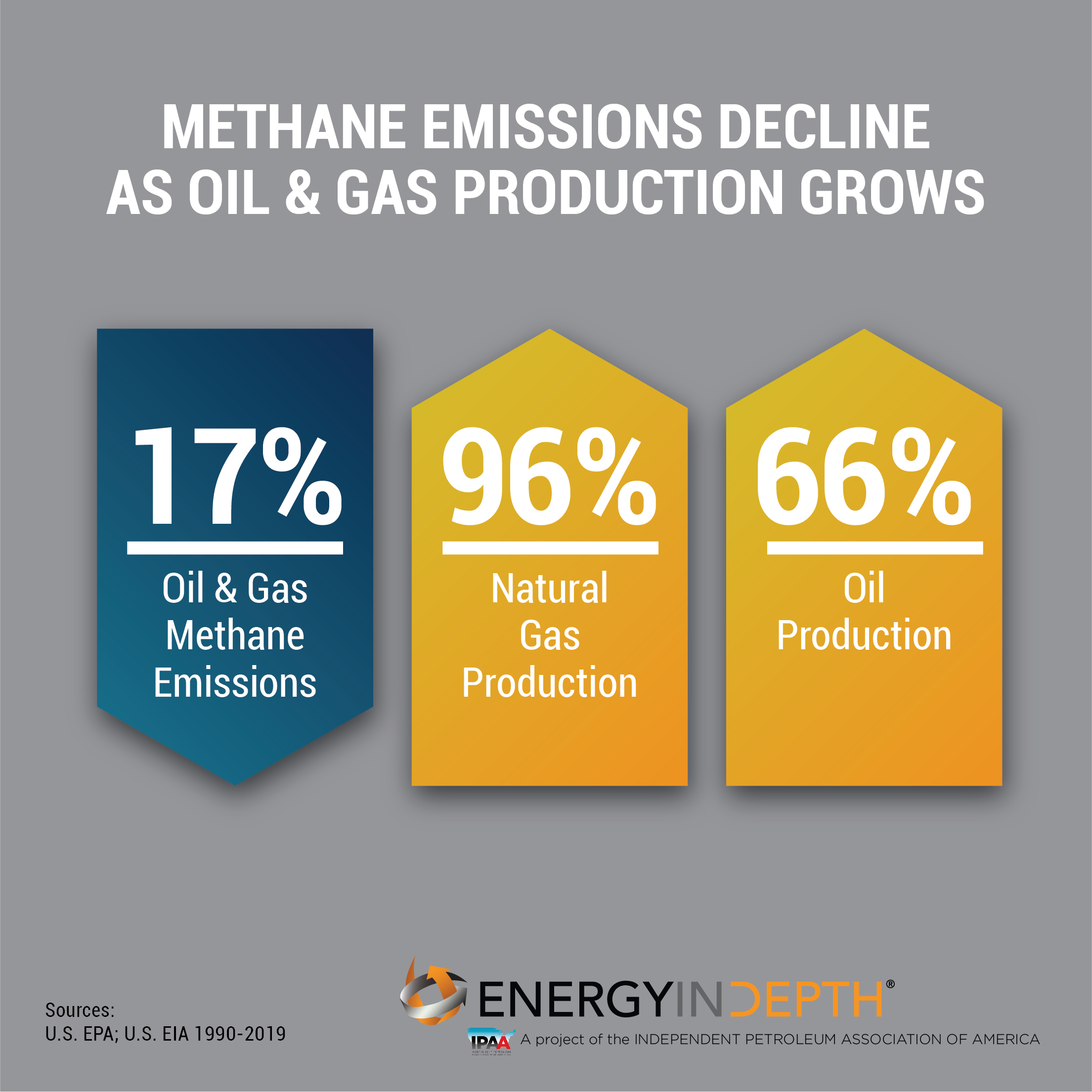
All of this tremendous progress reducing methane emissions has happened even as the United States became an energy powerhouse. The Environmental Protection Agency’s 2021 Greenhouse Gas Inventory showed that industry emissions have drop nearly 17 percent since 1990 while oil and natural gas production hit record levels.
A Cleaner Way To Keep The Lights On
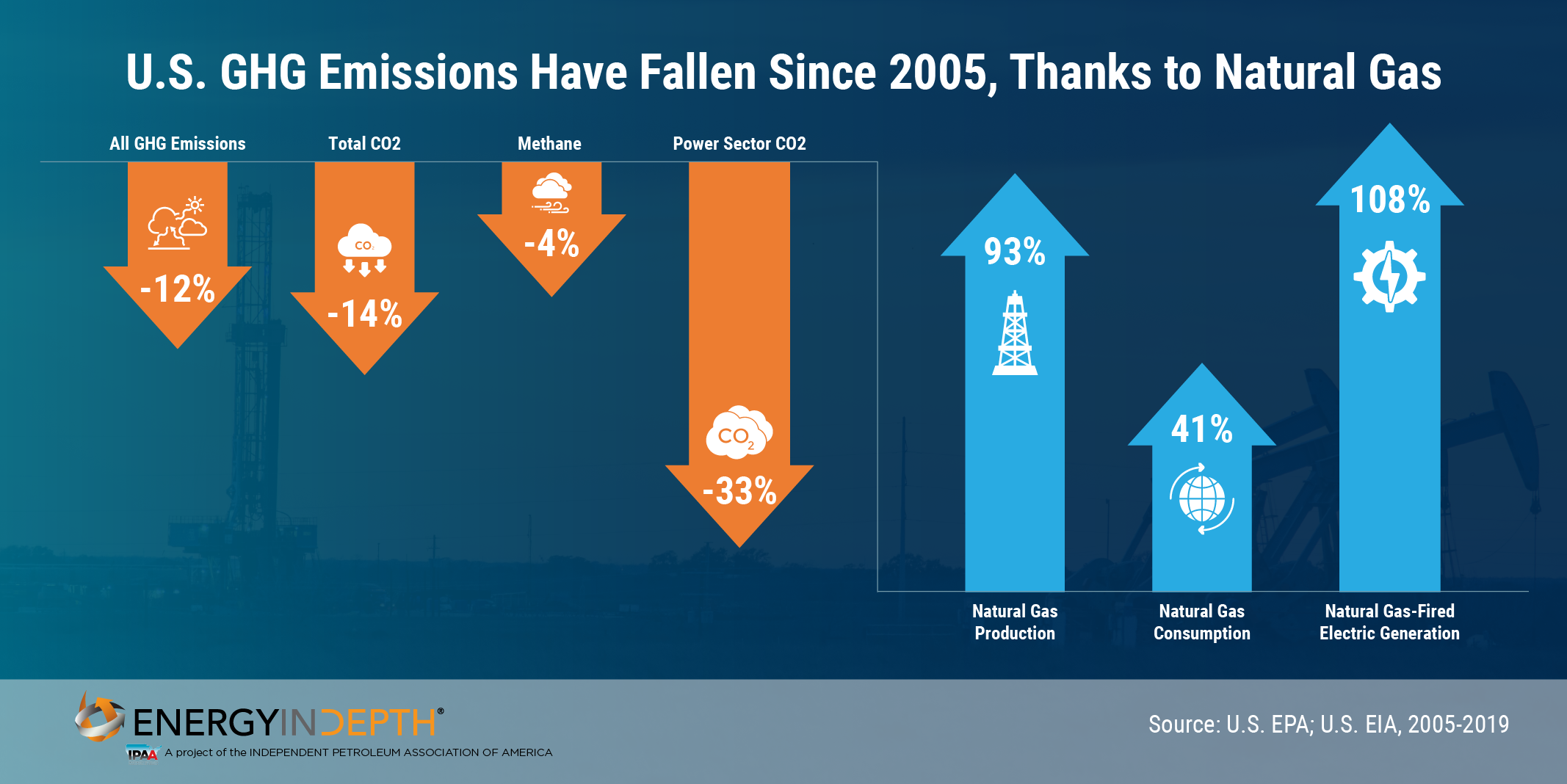
The cleaner-burning natural gas that’s being produced by these energy companies is playing a major role in lowering carbon emissions in power generation. A recent report from Berkeley Labs found that the U.S. power sector is “halfway to zero” carbon emissions with natural contributing nearly half of the decline. The report states:
“Natural gas generation grew from 761 billion kWh in 2005 to 1,617 billion kWh in 2020. Assuming this growth only displaced coal and considering the relative emissions rates of gas and coal, we estimate that increased natural gas supply reduced 2020 CO2 emissions by 470 MMT or 48 percent of the total emissions reduction since 2005.” (emphasis added)
Pioneering Carbon Capture and Storage Technologies
The development of carbon capture and storage technology has the potential to be a gamechanger in the fight against climate change. Already, major energy companies are deploying these systems to either capture carbon emissions before they are ever released or to snatch existing emissions right out of the air, and then storing that carbon deep underground.
The pace of innovation behind this technology has only sped up in recent years:
- Occidental’s Low Carbon Ventures business is storing approximately 20 million tons of CO2 per year and has developed partnerships with Carbon Engineering, 1PointFive, NET Power, Carbon Finance Labs, and XCHG. The company also has plans to capture the emissions from 50 industrial plants along its Midwest CO2 Superhighway.
- Earlier this year, ExxonMobil launched Low Carbon Solutions that “is advancing plans for more than 20 new carbon capture and storage opportunities around the world to enable large-scale emission reductions” and the company has already capture 120 million tonnes of carbon. The company is investing $3 billion over the next five years into this and other low carbon technologies. In fact, the company announced this week that it is investing in a $100 billion Houston-area facility that will remove 50 million tons of CO2 annually from the Houston Ship Channel region – the equivalent of taking nearly 11 million cars off the road.
- Shell, Total, and Equinor have also launched the North Lights project to store carbon off the coast of Norway, while Chevron has provided investment in the Canadian clean energy company, Carbon Engineering Ltd, to fast track bringing the company’s Direct Air Capture technology to market.
Billions Of Dollars Into Investment and Research & Development
Major energy companies are also investing in numerous other projects, technologies, and research & development efforts to produce affordable, accessible, and cleaner energy.
- BP has made major investments in renewable energy sources and infrastructure including a 50 percent stake in Equinor’s Massachusetts and New York offshore wind projects and in European solar company, Lightsource BP, which is building a large project in North Texas and acquired the United Kingdom’s largest electric vehicle charging company.
- BP also sponsors Princeton University’s Carbon Mitigation Initiative, which spearheads compelling, sustainable solutions to climate change and carbon emissions. In 2019, BP joined its peers in sponsoring the MIT Energy Initiative’s “Insights Into Future Mobility” study, that will examine personal mobility in cities, including transportation-facing climate change policies, alternative vehicle powertrains and fuels, and infrastructure options for charging and fueling.
- In the past two years, Chevron has moved forward with multiple efforts to support alternative energy including a four-year agreement alongside Algonquin Power & Utilities Corp to develop 500 megawatts from renewable sources to power its assets and it brought the first productionof 100 percent renewable base oil produced by both Chevron Products Company and Novvi LLC.
- Chevron has also increased electric vehicle accessibility in California in collaboration with ChargePoint and the California Energy Commission in late 2019 through infrastructural expansion and has provided research funding and scholarships to colleges nationwide, including Tuskegee University, Georgia Tech (alternative fuel development,2006), Colorado State University, UC Davis, California State University Bakersfield, University of Texas at Austin, and Texas A&M University.
- Since 2000, ExxonMobil has invested over $10 billion in the research, development, and deployment of emissions-lowering energy solutions, and has made critical contributions in the energy solutions space through the development of fuel cells, biofuels, methane emissions detection and reduction, and supported international biodiversity. Last year, ExxonMobil partnered with the National Renewable Energy Laboratory on the exploration of clean-burning algae-based fuels, and has pledged up to $100 million to support biofuel development. So, when activist groups like ClientEarth complain about ExxonMobil only investing 0.2 percent of capital expenditures into low-carbon energy sources, it ignores the fact that this is actually billions of dollars funding breakthrough technologies.
- ExxonMobil has also partnered with 84 universities and research institutions worldwide in recent years to drive innovative and more efficient energy technology development, including a $15 million investment into the University of Texas at Austin Energy Institute – to support cutting-edge energy technology research needed to meet growing global energy demand while still reducing environmental impact – and the MIT Energy Initiative – a collaboration to explore new energy sources and more efficient uses for conventional resources.
- In 2019, Shell committed $10 million to support Rice University’s Carbon Hub research initiative to harness oil and natural gas to create clean energy and advanced materials, which aims to facilitate emissions-free carbon materials production through the splitting of hydrocarbons.
These lists are far from exhaustive and merely scratch the surface of the many ways the U.S. oil and natural gas industry is investing in a lower-emissions future, both creating and succeeding in tackling the global challenge of climate change.