Newly published emails reveal that a Special Assistant Attorney General (SAAG) in the Maryland Attorney General’s office sought direction from a Bloomberg-backed group rather than the Maryland AG. This email exchange directly contradicts claims that these SAAGs, which are being placed in state AG offices around the country by the State Energy and Environmental Impact Center (SEEIC) at NYU Law School, are loyal solely to their respective attorney general.
The emails show SAAG John “JB” Howard, who was placed in the Maryland AG’s office through the Michael Bloomberg-funded SEEIC, seeking direction from SEEIC’s director on what his focus should be if he were to move into a potential new role. Looking to change from a focus on environmental issues to an energy position, Howard asked David Hayes, the Director of the SEEIC program, if he could discuss “what the Center envisions for these positions,” as well as “how the fellow would coordinate with the Center.”
This exchange contradicts SEEIC’s numerous claims that the SAAGs are not taking direction from the Center and instead receive their marching orders from their respective attorney general. Further, these emails show the influence the SEEIC – a group with a clearly stated “progressive” agenda – has over the SAAGs on their payroll and placed in the offices of elected officials.
EID has previously outlined the potential conflicts that the SEEIC program represents, including the placement of “midcareer environmental litigators” committed to “advancing progressive clean energy, climate change and environmental legal positions” in state attorneys general offices – thanks to $6 million in financial backing from a man who recently pledged $500 million to end coal and natural gas use. These conflicts, particularly the funding piece, have raised ethical questions about whether the SAAG’s loyalty lies with taxpayers or the outside organization paying their salaries which could have ulterior motives.
To address this, the SEEIC has attempted to maintain a veil of credibility and independence by stating that the SAAGs would be working for the respective state attorney general and his or her goals, not serving the wishes of the NYU program and Bloomberg. As the group’s website states:
“NYU pays the salaries of the law fellows, but the fellows’ sole duty of loyalty is to the attorney general in whose office he or she serves. All work performed by the fellows is entirely identified and managed by their respective AG offices.” (emphasis added)
The website again states these guidelines on the page on how to hire a SAAG:
“NYU Law pays the salaries of the SAAGs, and the State Impact Center provides ongoing support to the SAAGs and their offices. Consistent with legal obligations, the SAAGs’ sole duty of loyalty is to the attorney general who hired them.” (emphasis added)
Even the Director of the SEEIC, David Hayes, stated in a recent Wall Street Journal opinion piece that the SAAGs take orders from their Attorney General:
“The law fellows’ duties of loyalty and confidentiality run solely to state attorneys general, consistent with all applicable law.”
And yet, these emails show that might not be the case. As Howard stated in an email to Hayes in March 2019:
“I’m considering moving from my current environmental-focused position to the energy position that the Maryland AG’s Office has open. Would you have a few minutes this afternoon to call me? I want to get a little better sense that I currently have about what the Center envisions for these positions, which states have fellows and/or are particularly active on these issues, how the fellow would coordinate with the Center, and other things.” (emphasis added)
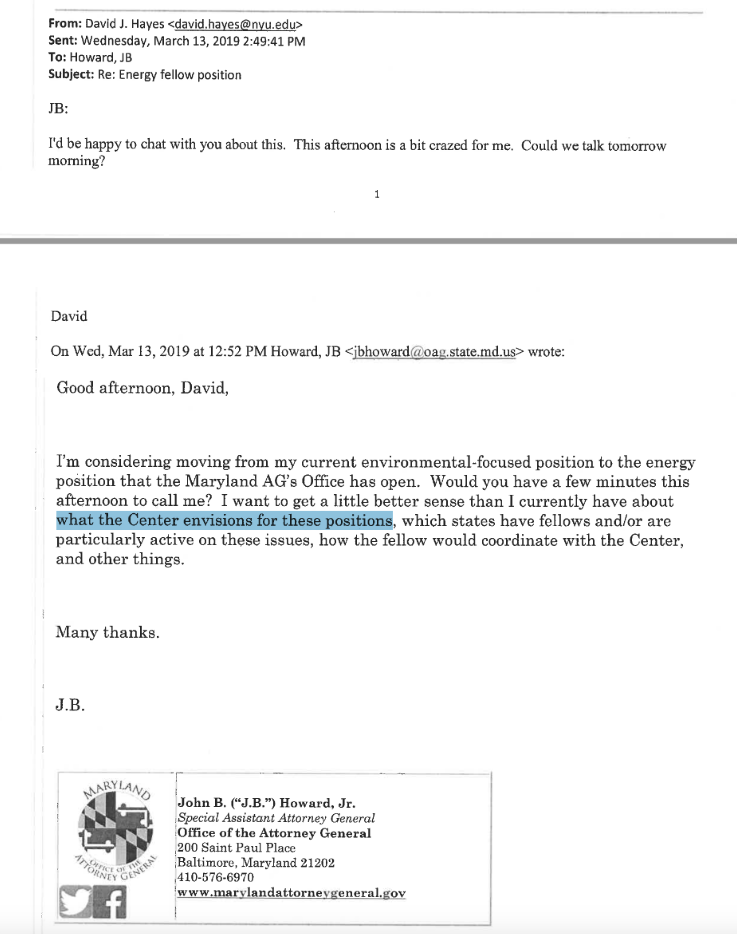 Hayes replied offering to help:
“I’d be happy to chat with you about this. This afternoon is a bit crazed for me. Could we talk tomorrow morning?”
This exchange raises a number of questions. First, why would Howard, who had been working as an SAAG since July 2018, need to get the direction on how he should approach the new energy position from Hayes rather than the Maryland AG? Second, considering Howard’s question about how a fellow would “coordinate with the Center” while in an energy-focused position, does that mean those SAAGs in energy roles are coordinating directly with the SEEIC, which Howard hadn’t done in an environment-focused position? And finally, if these SAAGs’ “duties of loyalty and confidentiality run solely to state attorneys general,” why is Hayes so eager to discuss what the “Center envisions for these positions,” as well as coordination?
Indeed, these emails pose more questions than answers. One thing seems to be clear, however, which is that the loyalty of these SAAGs is not “solely” to the state attorneys general that hire them.