The European Union recently announced plans to label natural gas as a sustainable fuel in the continent’s energy mix as it seeks to both lower emissions while meeting consumer demands for power generation.
The move is part of the EU’s “taxonomy for sustainable activities” – a labeling system to determine which fuel sources are best prepared to help Europe meet its energy and climate goals over the next 30 years. Natural gas was included because of its ability to replace higher carbon-emitting fuels while still providing reliable energy for residents and businesses and supporting the move toward a lower-carbon world.
The New York Times reports:
“The European Union has drawn up plans to classify some nuclear power and natural gas plants as green investments that can help Europe cut planet-warming emissions, a landmark proposal.” (emphasis added)
In a press release, the European Commission said that natural gas has a key role to play to “phase out of more harmful sources, such as coal, and in moving us towards a more low-carbon greener energy mix.”
This support for greater natural gas utilization comes as Europe faces an historic energy crisis that’s sent prices skyrocketing amid shrinking natural gas supplies and a reliance on imports from Russia.
By embracing natural gas, Europe could yield the same positive energy and environmental outcomes as the United States.
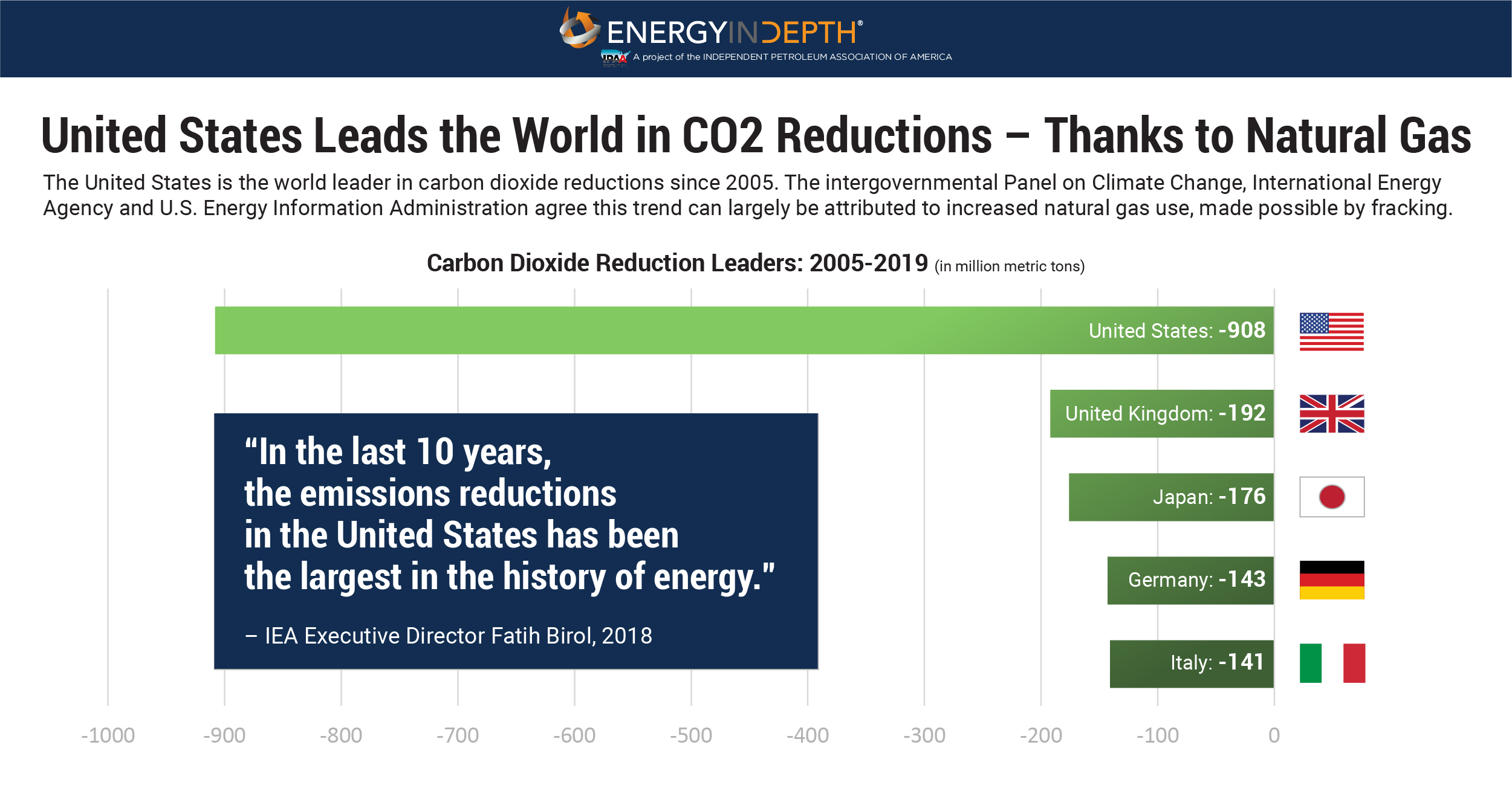
From 2005 to 2019, the United States was by far the global leader in CO2 emissions reductions thanks to a shift to greater consumption – especially for power generation – of the cleaner-burning natural gas unleashed during the shale revolution.

A U.S. Department of Energy 2021 report found that carbon emissions in the U.S. power sector have fallen by 52 percent since 2005 despite a projected increase earlier in the 21st century.
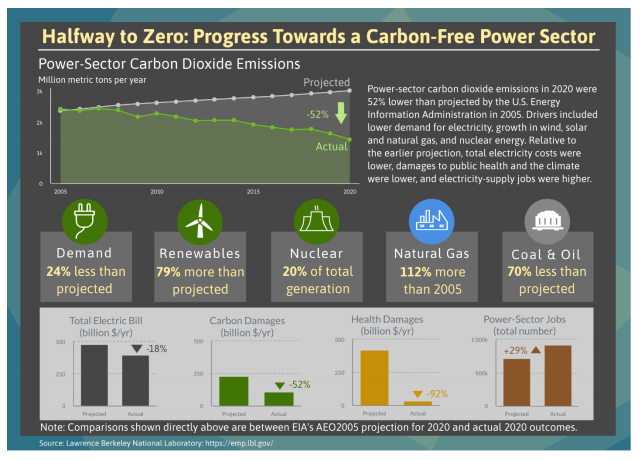
That was thanks to 112 percent more natural gas production in 2020 than in 2015, which helped lead the massive emissions cut. The report stated:
“Natural gas generation grew from 761 billion kWh in 2005 to 1,617 billion kWh in 2020. Assuming this growth only displaced coal and considering the relative emissions rates of gas and coal, we estimate that increased natural gas supply reduced 2020 CO2 emissions by 470 MMT or 48 percent of the total emissions reduction since 2005.” (emphasis added)
Natural gas has a key role to play as global energy markets undergo unprecedented transformations – a fact recognized even in regions with more aggressive climate policies like Europe.