Automakers are the latest to be named to a growing list of major industries, companies and groups who activists claim apparently knew about climate change individually but hid that information from the public. Yes, that’s right. First Exxon Knew, then Shell knew, then the utilities knew. But this begs the question, if “everyone knew” then how does the same iteration of this story keep getting written up as a new controversy?
Monday’s story in E&E News reports that scientists at General Motors and Ford had realized the connection between fossil fuel emissions from automobiles and climate change back in the 1960s, but, in learning that information, both companies undermined the connection in public reporting for years for fear of business disruption,
That fired up the usual #ExxonKnew echo chamber as activists quickly seized on the moment as further proof that energy companies should be held liable for climate impacts. The reporter behind the story even tweeted that she was given much of the research for the “monthslong investigation” from two well-known activists in the climate litigation campaign against energy companies, Carroll Muffett and Kert Davies.
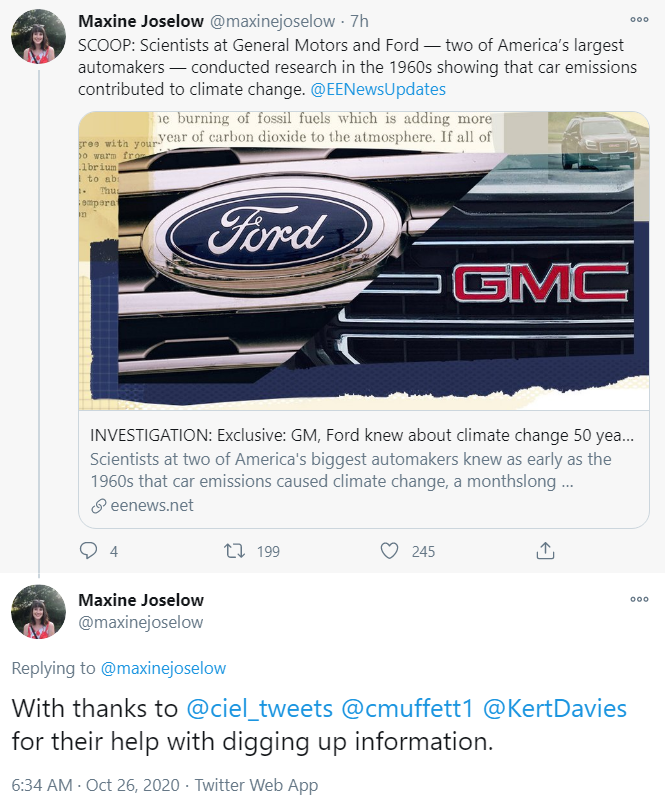
Other key players in the climate litigation also tweeted out the story including Harvard researchers Naomi Oreskes and Geoffrey Supran, whose deeply-flawed study on ExxonMobil’s private research and public communications has been cited in several of the climate lawsuits alleging that energy companies’ promotion, sale and marketing of fossil fuels worsened the impacts of climate change in U.S. municipalities.
But their excitement is quickly diminished by very basic logic.
The now-debunked “Exxon Knew” theory – the flawed claim that only ExxonMobil knew about climate change decades ago and suppressed that information from the public – simply cannot be true if numerous other corporations also knew about climate change at the same time. In fact, Monday’s E&E News article is just the latest a long string of stories that show all sorts of companies and organizations knew about climate change in the 1960s and 1970s.
The only thing that’s been proven with this most recent story is that apparently “Everyone Knew” about climate change and the idea that a small handful of scientists and executives singlehandedly misled the entire world is complete bunk.
The “Exxon Knew” Activists Behind the Story
To no one’s surprise, the E&E News story was orchestrated by two well-known activists in the climate litigation campaign as the reporter noted on Twitter.
Carroll Muffett is the president of the Center for International Environmental Law – an organization that’s played a major role in pushing the “Exxon Knew” theory, counts plaintiffs’ lawyers Matt Pawa and Sharon Eubanks as board members, and has compared the energy industry to tobacco. Previously, Muffett worked at activist groups including Greenpeace and Defenders of Wildlife, and he attended the Rockefeller meeting in 2016 where activists plotted ways to “delegitimize” ExxonMobil.
Kert Davies runs the Climate Investigations Center, which has been criticized for “using dishonest and potentially unlawful business practices and wasting tax dollars to engage in its investigations,” and last year published stale documents trying to advance the “Exxon Knew” theory even as the New York Attorney General’s case was going down in flames. Like Muffett, Davies used to work for Greenpeace, and he sits on the board of Climate Communications & Law – the parent organization of Climate Docket, a website dedicated to promoting the climate litigation campaign.
The activists pushing this story is just another example of the extensive coordination that supports the climate litigation campaign, but in this particular case, the story backfired, as it totally undercuts the theory that only major energy companies knew about climate change and hid that information from the public.
“Exxon Knew” Has Long Been Debunked
The “Exxon Knew” theory has been the central argument in nearly all the climate lawsuits filed against the company in recent years. It was put to the test in the New York Attorney General’s investigation into ExxonMobil in 2015, but former Attorney General Eric Schneiderman was forced to abandon the claim because he simply didn’t have any evidence. Yet, Schneiderman’s office continued to investigate the company under new theories for three more years, reviewing over four million ExxonMobil documents in the process. Only after being told to “put up or shut up,” did the New York attorney general’s office bring a case of weak accounting claims against the company. The pair downed cased was dealt a comprehensive defeat by a New York State Supreme Court justice in 2019.
Other cases like those filed by the attorneys general in Connecticut and Minnesota continue to talk up the “Exxon Knew” theory but as New York has proven, when push comes to shove, there is simply nothing there.
It’s More Like “Who Didn’t Know?”
In addition to Schneiderman’s investigation that came up completely emptyhanded, the other fatal blow to the “Exxon Knew” theory is that apparently all sorts of other companies and organizations knew about climate change.
E&E News – the same outlet that wrote the story on the automakers – published an article in 2018 that every U.S. president since John F. Kennedy has been briefed on climate change. In 2017, the anti-energy Energy and Policy Institute said that electric utilities also knew about climate change, while activists have also chimed in that the American Petroleum Institute, Chevron, and Shell all knew, too. A New York Times Magazine issue published in 2018 devoted to the scientific understanding of climate over the years even plainly stated that “Everybody knew.”
Not only did every president since the 1960s and all these major corporations know about climate change, but also any person who followed the news at that time would have also known. In 1956, TIME magazine published an article linking a buildup of CO2 to climate impacts while Bell Labs produced a video on the issue, too. The E&E News story mentions that NASA scientist James Hansen testified to Congress about climate change in 1988, which prompted front-page coverage in the New York Times. It doesn’t get much more public than an above-the-fold story in America’s biggest newspaper.
All of these examples of widespread understanding about climate change only shows that activists are grasping at straws as they wage a politically motivated litigation campaign against energy companies.