Citing the transparent political motives and national focus of Massachusetts Attorney General (MAAG) Maura Healey’s lawsuit, lawyers for ExxonMobil have moved the MAAG’s case to federal court, according to a filing from last week.
Healey originally launched her lawsuit against ExxonMobil in October claiming the company misled consumers and investors by not placing warning labels on their gas pumps and advertisements. From the beginning, it was clear that Healey and her activist allies were more interested in making a political statement than “protecting consumers.”
Massachusetts’ lawsuit reads more like an activist wish list than a well-argued complaint based on solid evidence and facts. Indeed, during the three years of investigation leading up to the lawsuit, Healey took no depositions of company employees and did not procure any internal documents from the company.
Now, ExxonMobil is pushing back. Healey initially filed the case in state court in Suffolk County, but ExxonMobil argues that the case belongs in federal court. In their Notice of Removal, ExxonMobil argued that Healey’s attempt to try the case in state court despite federal and even international questions at hand is proof of her disingenuous claims against the company:
“When viewing the Complaint’s allegations in this context, it becomes even clearer that this suit is neither about consumer protection, nor properly brought under state law. It instead seeks to wade into complex federal statutory, regulatory, and constitutional issues and frameworks, and to substitute one state’s judgment for that of longstanding decisions by the federal government about national and international energy policy and environmental protection. A suit of this nature should be heard, and promptly dismissed, by a federal court.”
Furthermore, the company made clear that the suit is part of a broad scheme to carry out the wishes of activists and avoid the burden of having to deal with duly-elected public officials:
“While purportedly brought under state law and in the name of consumer protection, this lawsuit by Plaintiff the Commonwealth of Massachusetts, acting through its Attorney General, is the culmination of a multi-year plan concocted by plaintiffs’ attorneys, climate activists, and special interests to force a political and regulatory agenda that has not otherwise materialized through the legislative process.”
ExxonMobil also said the lawsuit was advancing a preferred political agenda and limiting free speech:
“From the day MAAG announced the underlying investigation to its recent rush to file this lawsuit in the midst of the trial of a similar suit brought by the New York Attorney General, it has been abundantly clear that MAAG has been engaged in a pretextual use of its law enforcement power to further a political agenda, bar ExxonMobil from participating in the public discourse about climate change, and force a societal change toward what MAAG deems a “clean energy future.”
ExxonMobil also cited Healey’s past comments showing that she’s not conducting a fair investigation:
“Attorney General Healey’s specific remarks echoed this agenda, proclaiming ‘there’s nothing we need to worry about more than climate change,’ and pledging to undertake ‘quick, aggressive action’ to alleviate the threat to ‘the very existence of our planet’ by moving the country toward a ‘clean energy future.’ Her comments also made clear that her ‘investigation’ had a preordained conclusion—that ExxonMobil had engaged in deception.”
Healey Supported by Activists All Along
Healey has made no secret that she’s been willing to rent out her government office to activists looking to destroy energy companies.
She was part of the 2016 press conference hosted by then-New York Attorney Eric Schneiderman for the introduction of a coalition of nearly 20 state attorneys general dubbed the “AGs United for Clean Power.” It was at that press conference where she announced her plan to join other AGs in an investigation ExxonMobil, though ultimately only Healey and Schneiderman announced investigations.
These actions by state attorneys general were part of the strategy developed at the infamous La Jolla conference in 2012 were activists gathered to plot ways to bring litigation against major oil and gas companies, including recruiting “a single sympathetic attorney general” to conduct investigations.
At that conference was Matt Pawa, a lawyer who made his name suing energy companies. In 2016, Pawa met with attorneys from Healey’s office to present his litigation strategy.
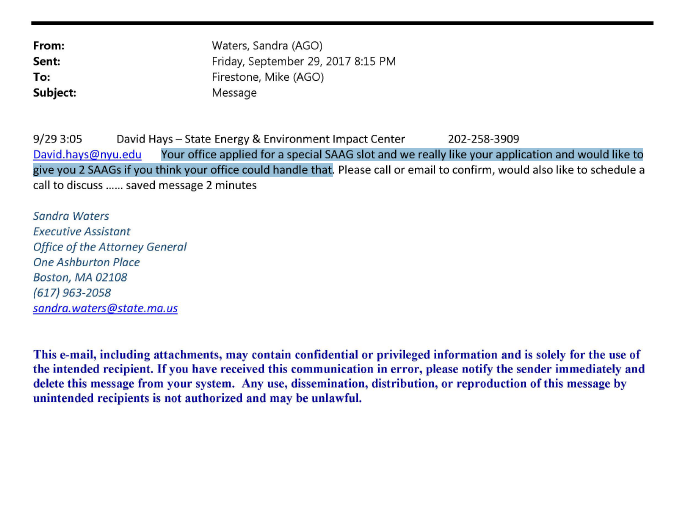
Healey’s office also brought on two fellows from the Bloomberg-funded State Energy & Environmental Impact Center at the NYU Law School – a program where the privately-paid lawyers work in state AG offices specifically to assist with litigation to advance “progressive clean energy, climate change, and environmental legal positions.” At least one of New York’s two Bloomberg fellows worked on the state’s lawsuit against ExxonMobil.
The Union of Concerned Scientists knew the Bay State was friendly territory and hosted it’s “secret meeting at Harvard” in 2016 where it presented its “Potential State Causes of Action Against Major Carbon Producers.” Five attorneys from of Healey’s office were present. Harvard historian and anti-ExxonMobil activist Naomi Oreskes also participated in the forum.
Conclusion
As ExxonMobil pointed out in their notice, Healey has never been interested in conducting an honest investigation. Instead, she’s worked with activists as part of a broader campaign to attack the company and advance a political agenda. Healey wants the case to be heard in state court, where she believes she stands a better chance of success, but the claims raised in her complaint clearly call for a federal verdict.