Politico’s recent energy newsletter echoed misleading claims often heard in the oil and natural gas industry that deserve a more thorough examination. The newsletter focused on the $369 billion climate bill signed into law by President Joe Biden that includes a tax on methane emissions, noting the significance this policy could have on mitigating greenhouse gas emissions.
Setting aside debate on this tax on natural gas, there are certain facts that should be put into perspective when analyzing the U.S. oil and gas industry, its role in methane emissions, and the many innovative strides the industry is making to lead the clean energy revolution that are often left out of media reports.
Newsletter claim #1: “Even in its diluted form, the policy could help clean up emissions at a crucial time. Methane concentrations in the atmosphere are rising rapidly, sparking fears among scientists that it could prevent the world from meeting its climate goals.”
Reality: While data does show evidence of rising methane concentrations globally, they aren’t coming from the United States. In fact, the Environmental Protection Agency’s 2022 Greenhouse Gas Inventory shows that U.S. methane emissions have continued to fall, even with increases in domestic energy consumption and production. Total U.S. greenhouse gas (GHG) emissions are down 20 percent since 2005, including continued reductions of both carbon dioxide (CO2) and methane (CH4).
What’s more, the United States leads the world in oil and natural gas production, but it’s far from the largest emitter of methane. That title belongs to Asia, the continent that includes the global economies of China, Russia, and India. North American methane emissions accounted for a fraction of those coming from Asia, according to GHGSat’s latest methane emissions report, which tallied Asia at a whopping 69 percent, more than four times that of North America.

Adding even more perspective to this GHG gap, in 2021, Asia emitted about 48 million metric tons of CO2 equivalent, compared to just under 12 million MTCO2e that originated in the United States.
Newsletter Claim #2: “Methane is a highly potent greenhouse gas emitted in a variety of agricultural and industrial activities, most prominently by the oil and gas industry.”
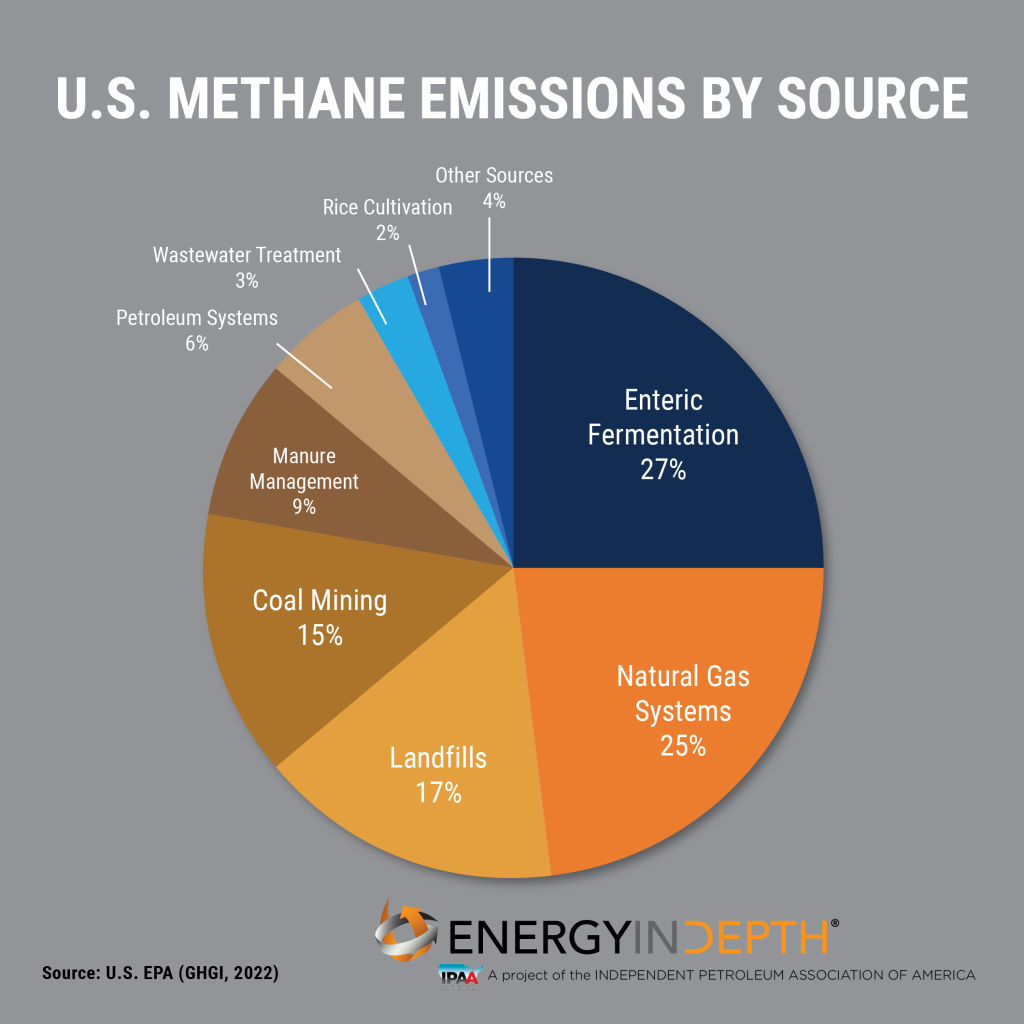
Reality: There’s no debate that methane is a potent greenhouse gas, but most methane emissions do not come from the oil and gas industry as this line insinuates, but from agriculture. The EPA’s Greenhouse Gas Inventory report further explains:
“In 2020, agricultural soil management was the largest source of N2O emissions, and enteric fermentation was the largest source of CH4 emissions in the United States.”
Limiting methane emissions is no doubt an important piece of the overall greenhouse gas emissions challenge, but singling out the oil and gas industry as the most “prominent” contributor leaves out important context.
Newsletter Claim #3: “’It further positions the U.S., after decades of dawdling on methane, to begin to make some serious progress,’ Rabe said.”
Reality: The United States is a leader on methane reduction – not a dawdler. For years, states have been aggressively addressing greenhouse gas emissions and companies across the oil and gas industry have been innovating to meet increased Environmental, Social and Governance (ESG) demands.
Growing technological advancements have helped companies detect and mitigate methane leaks. For example, the 2021 Environmental Partnership report found that companies have replaced tens of thousands of pieces of equipment to prevent methane leaks and conducted hundreds of thousands of surveys and inspections. Companies have proactively increased aerialsurveillance, installed methane monitoring equipment, modernized processes, and more. Global partnerships and ratings scales also exist to help companies prove their methane reduction bona fides to investors, regulators, and consumers alike.
In addition, the growing shift to natural gas for power generation has been a huge boon in reducing methane and carbon dioxide emissions.

In 2020 alone, the shift to natural gas provided an emissions reduction of 562 million metric tons of CO2 (MMT CO2), according to recent EIA reporting by the Energy Information Administration. That’s the emissions equivalent of 150 coal-fired power plants operating for a year! And since 2005, the increased use of natural gas for power generation has led to emissions reductions of 3,871 MMT CO2, or the same as removing more than 834 million gasoline-powered vehicles off the road.
Bottom line: The U.S. oil and gas industry takes its role in mitigating greenhouse gas emissions seriously and is leading the charge on the world stage for a cleaner energy future. The idea that nothing happens unless the federal government acts is silly and ignores the years of innovative work happening across the country. Further scrutiny shows: the U.S. oil and gas industry is part of the solution in developing clean, reliable and affordable energy to meet global energy demands.