The Federal Judicial Center (FJC) has removed a contentious climate science chapter from its cornerstone Reference Manual on Scientific Evidence after mounting criticism revealed the section was written and reviewed by prominent figures involved in the climate litigation campaign targeting U.S. energy companies.
The controversy erupted soon after the FJC released an updated edition of the manual, an influential resource intended to provide judges with neutral guidance on complex scientific issues. Published in December, the edition included a new climate science chapter authored by Columbia’s Sabin Center fellow Jessica Wentz and climate scientist Radley Horton, and reviewed by Sabin Center executive director Michael Burger – central figures in the climate litigation campaign, whose track records undercut any pretense of neutrality.
After state attorneys general urged Congress to probe the document’s development and pressed the FJC directly to withdraw the climate science chapter, West Virginia Attorney General J.B. McCuskey said Friday on X that the agency had notified him the chapter had been “omitted” from the manual:
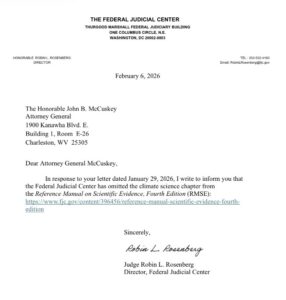
McCuskey called the move a “win for impartiality in our judiciary,” but questions remain about how the manual was developed and who shaped its contents.
The document’s introduction and the “How Science Works” chapter still cite Harvard professor Naomi Oreskes, who was credited by The New York Times with helping “conceive” the 2012 La Jolla conference that mapped out the entire climate litigation strategy and who later served as a consultant to climate litigation plaintiff law firm Sher Edling.
In an editorial titled “A failed climate coup in the courts,” The Wall Street Journal argued the episode warrants closer scrutiny:
“This might be a case of all’s well that ends well, except that someone on the Judicial Center was either asleep or tried to slip ideology into what should be ‘a dispassionate guide,’ to borrow Justice Kagan’s words. A public accounting of how that happened would be useful.” (Emphasis added)
A Years-Long Campaign of Judicial Capture
Activist efforts to target the FJC and the federal judiciary predate the manual controversy and reflect a broader, years-long campaign to shape how judges approach climate litigation.
Central to that effort is the Climate Judiciary Project (CJP), an initiative of the Environmental Law Institute (ELI) launched in 2018. The program has briefed more than 2,000 judges on climate litigation, and is currently under investigation by the U.S. House Oversight & Government Reform Committee for alleged attempts to undermine the impartiality of judges.
Although presented as educational, unbiased information, CJP is led by scholars including Jessica Wentz and Pat Parenteau, a University of Vermont law professor who has also advised Sher Edling.
Additionally, Ann Carlson, a UCLA Law School professor who also served as the Chief Counsel and Acting Administrator of the National Highway Traffic Safety Administration during the Biden administration, was also on CJP’s Advisory Curriculum Committee, and helped coordinate strategy and funding for climate lawsuits among the Rockefeller network and Hollywood star Leonardo DiCaprio. The administration withdrew her nomination to assume the role permanently in 2023 after Sen. Ted Cruz had shone a spotlight on her work on behalf of the litigation campaign.
Last month, the U.S. House Judiciary Committee sent a letter to the FJC raising concerns about potential improper influence tied to the project:
“Public reports have documented concerns around apparent efforts by ELI and CJP to influence judges who potentially may be presiding over lawsuits related to alleged climate change claims. These efforts appear to have the underlying goal of predisposing federal judges in favor of plaintiffs who allege injuries from the manufacturing, marketing, use, or sale of fossil fuel products.”
Public records indicate CJP’s engagement with the FJC dates back to at least 2021, when the National Academy of Sciences, Engineering and Medicines organized a conference with the FJC to identify topics for the Fourth Edition. During that process, CJP founder Paul Hanle hosted a panel discussion and emailed participants beforehand asking them to consider how their perspectives could be reflected in the manual:
“Main question for today: what should a reference manual on scientific evidence say on what is known about [climate change]? What should be included in the chapter – topics to cover?”
Separately, notes from CJP’s Fall 2023 Curriculum Advisory Committee Meeting included a discussion specifically on judicial capture labeled, “Dissemination – How to put material in the hands and head of judges who need it.”
Additionally, email correspondence from Hanle and Sandra Nichols Thaim, judicial education director at ELI, outlined a 2020 virtual discussion focused on the judiciary, including: “how can we best push participant’s thinking and understanding while remaining neutral and without crossing the lines of material appropriate for program with judges?”
This dynamic was also discussed during a recent Federalist Society panel, where Carrie Severino of the Judicial Crisis Network described what she characterized as a broader strategy to influence the federal judiciary:
“If you look at the nature of the people involved in this, these are some of the same people and organizations that are also helping push a lot of the litigation.”
Bottom Line: After sustained criticism, the Federal Judicial Center removed the climate science chapter from its Reference Manual following the blatant attempt by climate litigation supporters to influence judges – a campaign that’s been years in the making, led by the Climate Judiciary Project.