U.S. oil and gas producers continue to achieve emissions reductions progress despite record high production levels, according to the Environmental Partnership’s newly released annual report. Methane emissions fell by 40 percent since 2015 even as production grew by more than 50 percent.
Today, The Environmental Partnership has released its 7th annual report, highlighting continued progress in reducing methane emissions—down over 40% across U.S. onshore production regions since 2015, even as production rose by over 50%.
Explore this year’s key highlights and…
— American Petroleum Institute (@APIenergy) September 16, 2025
The Environmental Partnership (TEP) is a longstanding, voluntary industry coalition, whose members represent nearly 65 percent of U.S. onshore oil and natural gas production. The organization partners with companies in 47 out of the 50 states, supporting members in improving their environmental performance through a partnership of innovation and collaboration. Vanessa Ryan, Chair of The Environmental Partnership and general manager of climate and engagement for Chevron, emphasized:
“Through collaborative industry initiatives like The Environmental Partnership, companies are working together to find pragmatic and scalable solutions that minimize waste and achieve the highest level of operational performance.”
Since its inception in December of 2017, member companies have worked together to innovatively improve their environmental performance in key areas including improving flaring efficiency and leak detection and repair which have helped drive methane emissions reductions.
Reductions in Methane Emissions
Industry’s success in reducing methane emissions can be clearly seen in recent data from the Environmental Protection Agency’s Greenhouse Gas Reporting Program, which details how each of America’s top seven oil and gas producing basins saw a decrease in their total methane emissions over recent years. The same success is reflected in TEP’s report.
Methane reduction is a strategic priority of TEP, as the organization is committed to its goal to reduce methane intensity by 75 percent by 2030. Through 2024, TEP has achieved a 59 percent reduction in methane intensity. Member companies are continuing to pursue further reductions through strategies such as converting natural gas-driven pneumatics to non-gas-driven alternatives, a practice widely recognized as an effective way to reduce methane emissions. As Emily Hague, director of The Environmental Partnership said:
“Reducing methane emissions is an important and complex challenge—there’s no one-size-fits-all solution. TEP helps operators explore the full range of solutions, make informed choices for their unique operations, and continuously improve strategies to deliver America’s essential oil and natural gas efficiently and responsibly.”
To build on its original methane initiative, this year, TEP launched an employee awareness and engagement program called Methane Matters. The program equips employees with tools and knowledge to support the methane intensity reduction goal, with the understanding that sustainability strategy must be integrated at every level of the company.
TEP’s seventh annual report reaffirms what previous reports have revealed: collaboration is key for solving industry-wide challenges. With methane emission reductions being top of mind for many companies, TEP’s aligned commitment to further reductions, as well as its facilitation of information-sharing and innovative ideas, will advance its goal of improving industry environmental performance.
Progress in Flare Efficiency
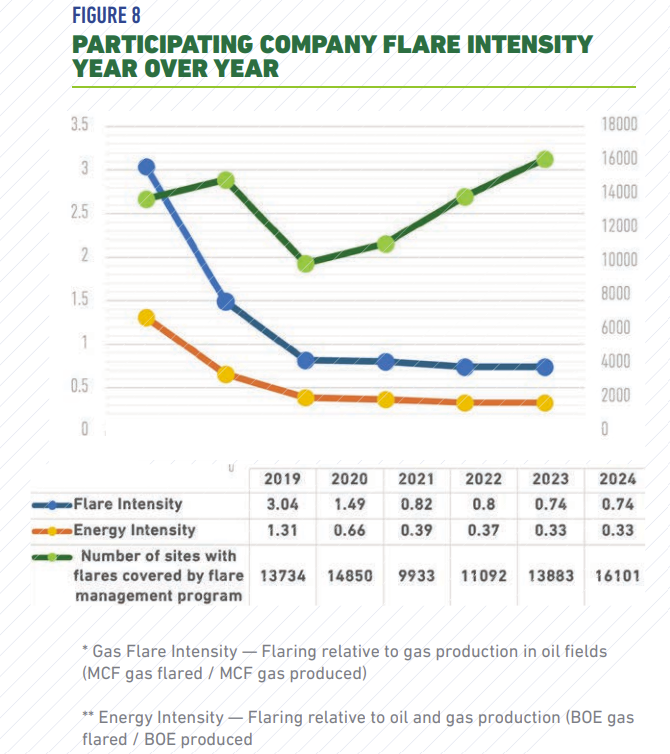
Since TEP introduced its flare management program in 2020, participating companies have achieved significant milestones in reducing overall flare volumes and flare intensity.
In 2024, flare intensity among TEP member companies fell to only 0.74 percent, showcasing an overall reduction of more than 75 percent since 2020. Even as companies increased the sites analyzed in the flare management program by over 16 percent last year, and 62 percent since 2021, reported flare and energy intensities have remained flat.
Detection and Repairment of Leak Improvements
Since TEP’s inception, participating companies have worked to implement innovative leak detection and repair (LDAR) programs. TEP’s reporting reveals that participating companies are taking detection efforts to another level, prioritizing innovation in their LDAR programs to utilize advanced detection technologies, inspect more sites, and conduct more frequent inspections.
In 2024, TEP companies inspected over 199,000 sites, two-thirds of which were voluntary inspections beyond regulatory requirements.
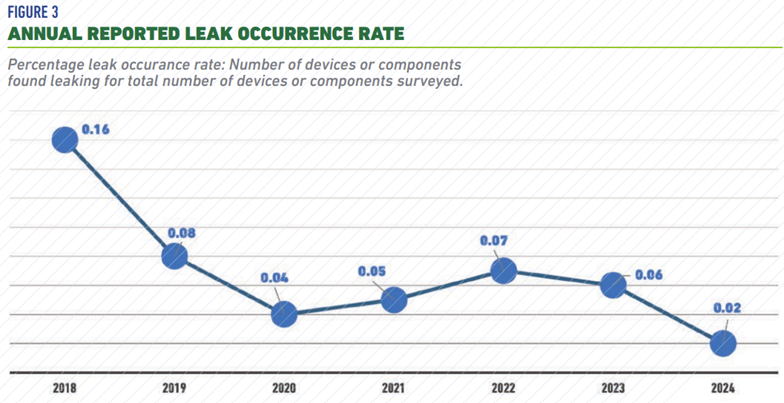
Thanks to these innovative efforts, participating companies were able to reduce leak occurrence rates to 0.02 percent among the sites surveyed in 2024.
Bottom Line: The Environmental Partnership’s annual report once again confirms that the United States is not only a leader in oil and natural gas production, but is also a leader in emissions reduction and other environmental progress.