Methane emissions from the country’s top oil and gas-producing basins have fallen 44 percent since 2011, according to data from the Environmental Protection Agency. This plunge in emissions comes even as the country has managed to shatter energy production records – the United States produced more crude oil than any nation at any time for the past six years in a row.
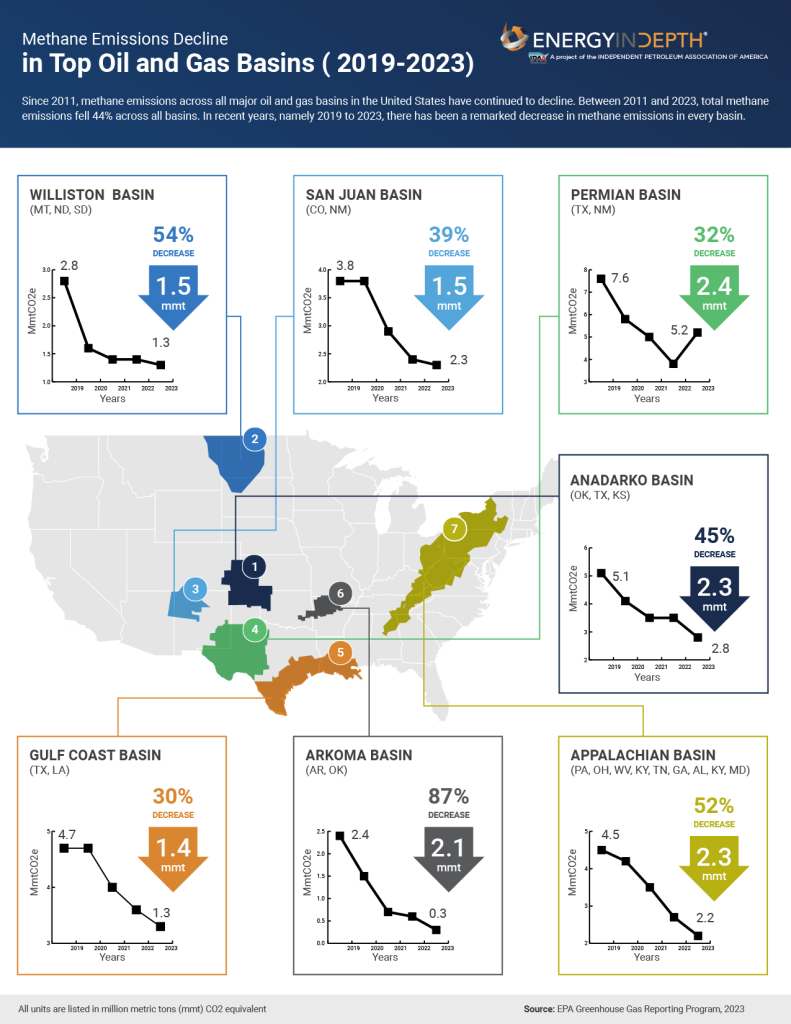
These newest figures on methane emissions come following the release of 2023 data from the EPA’s Greenhouse Gas Reporting Program. The data, which can be broken out by basin, reveals that the massive reduction in methane emissions holds true across the board: each of America’s top seven oil and gas producing basins saw a decrease in their total methane emissions over recent years.

Three basins saw their methane emissions fall by more than half from 2019 to 2023 – Williston Basin (which covers parts of Montana, North Dakota and South Dakota), Appalachian Basin (which spans a long stretch down nine eastern states including Ohio, Pennsylvania and West Virginia) and Arkoma Basin (covering parts of Arkansas and Oklahoma). Arkoma Basin emissions plummeted most drastically – declining 87 percent.
In the Permian Basin, which spans West Texas and eastern New Mexico, total methane emission fell 32 percent between 2019 and 2023, or by 2.4 million metric tons (MMT). Annual reporting from Texans for Natural Gas has shown an ongoing decline in methane intensity in the Permian over those years as well – from 0.29 percent in 2019 to 0.12 percent in 2022.
Concurrently, total Permian production increased 51 percent, from nearly 7 million barrels of oil equivalent per day (boe/d) in 2019 to 10.6 million boe/d in 2023. What’s more, those production numbers are only set to rise. The Energy Information Administration (EIA) projects that crude oil production in the Permian will grow by 430,000 b/d in 2023, bringing the basin to 6.3 million b/d in 2024 and 6.6 million b/d in 2025.
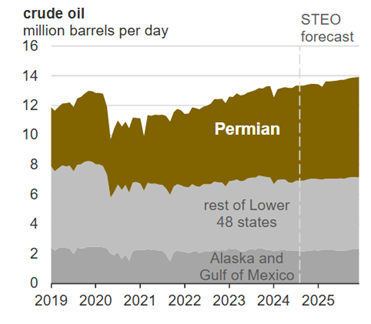
Permian crude oil production from Jan. 2019 – Dec. 2025 outpaces the entirety of the lower 48 states combined. Source: EIA
A separate EPA report from earlier this year conducted alongside the Clean Air Task Force echoed these findings. The study found that from 2015 to 2022, methane emissions from oil and gas production fell by 37 percent. A similar story emerged when examining emissions intensity – both methane and greenhouse gas emissions intensity declined 31 percent and 17 percent, respectively, between 2020 and 2022. The report also revealed that emissions from venting, flaring, and fugitive sources all fell significantly from 2015-2022.
These wins in emissions reductions come amid industry’s efforts to collaborate and apply monitoring and emissions reductions solutions. Industry groups like the Oil and Gas Methane Partnership, The Environmental Partnership, the Texas Methane and Flaring Coalition, and ONE Future have brought some of the country’s top oil and gas producers together with aims like improving methane emissions reporting, committing to end routine flaring, and sharing best practices for emissions detection.
Bottom Line: The United States has long been an energy leader, and its commitment to reducing energy emissions has only further solidified that status. American oil and gas producers have proven that they can output record-breaking volumes while still pushing for a cleaner future.
Check out EID’s new fact sheet showing the breakdown of methane emissions by top-producing basins.