In a recent interview with Minnesota Public Radio, Minnesota Attorney General Keith Ellison said he does not know who funds the State Energy & Environmental Impact Center at New York University Law School – the program that has paid the salaries of two Special Assistant Attorneys General (SAAGS) serving in his office that have played a major role supporting his climate lawsuit against energy producers.
During the interview, MPR host Mike Mulcahy asked Ellison about his use of these SAAGs, who are supported by a Michael Bloomberg-financed program, and which has been under scrutiny by a Minnesota State Senate committee, as EID Climate noted last month:
“What about this issue that your office employs at least one lawyer, maybe two, that is being funded by a nonprofit with money from the Michael Bloomberg family foundation. There is a bill in the state senate that would actually stop that. Is that a good practice because it seems like it could be used by another attorney general to you know hire someone funded by the Donald Trump family foundation or some other foundation?”
Ellison initially responded to Mulcahy that he did not know where the money is coming from to pay for these SAAGS:
“Now, where do they get their money from? Truth be told, I know more about that from our detractors than I do from the contract grant.”
But Ellison then acknowledged the role that Bloomberg money plays in this arrangement but feigned ignorance:
“I don’t dig into who the donors are so I’m hearing about this all from a third party. But according to the critics, the foundation that Michael Bloomberg started, which is governed under the laws of the state of New York, which has an independent board that makes decisions, which is a professional charitable foundation, donated to New York University. And then New York University set up the program.”
Ellison is on the right path – showing he knows a lot more than he’s letting on – so, here’s a helpful explainer for anyone else wanting to know about the money behind the SAAGs serving in his office.
In 2017, the Washington Post reported that money from Michael Bloomberg set up the program:
“NYU School of Law will launch a new center, financed by Bloomberg Philanthropies, aimed at helping state attorneys general fight any federal moves to roll back renewable energy, environmental protections, and climate policies.
“The grant of nearly $6 million, which will establish the State Energy and Environmental Impact Center, marks a new step in the escalating battle between state attorneys general and the Trump administration over the nation’s energy and environmental trajectory.”
A review of the SEEIC’s website and the Law Fellow Program shows that Bloomberg-funded SAAGs are serving in the Minnesota Attorney General’s office and discusses how it works:
“In 2017, following the launch of the State Impact Center, all attorneys general and their senior staff were invited to apply to the NYU Law Fellow program. Interested attorneys general described their need for additional support on clean energy, climate, and environmental matters, and certified that they could participate in the program under applicable federal and state laws.
“NYU pays the salaries of the law fellows, but the fellows’ sole duty of loyalty is to the attorney general in whose office they serve.” (emphasis added)
It’s worth noting these attorneys don’t show up on their own accord. Ellison had to make a detailed request to the NYU program for why he needed the Bloomberg-funded attorneys’ help, and the application sent to Ellison even names Bloomberg Philanthropies in addition to linking to the Washington Post’s coverage.
Then, in 2020, Ellison filed his climate lawsuit, and in the press conference announcing the case, acknowledged the two Bloomberg-funded SAAGS – Leigh Currie and Peter Surdo, and thanked both for their “excellent, excellent work” putting the case together. Both Currie and Surdo are listed as counsel on the complaint.
Thanks to a few simple internet searches – or even just reading the application – it’s that easy. And if Ellison wanted to know more, he could have tuned into the recent state senate hearing where a staff member from his own office testified and was pressed to provide transparency about the Bloomberg-funded SAAGs from Sen. Mary Kiffmeyer:
“The Bloomberg-funded [SAAGs] around the country are refusing to produce documents in response to data practice requests in over 35 matters involved in activist attorneys general in other states. As we are hearing today, a representative of the [Minnesota] Attorney General’s office on this very topic did not come prepared to give information to this committee which has authority in this area.”
But wait, there’s more…
Additional Behind-the-Scenes Support
Later in that same answer on the Bloomberg program, Ellison also claimed:
“I don’t deal with the donors. At all. I have no contact with them at all.”
Well, Ellison might not be having personal conversation with Michael Bloomberg or his associates, but he’s certainly talking to plenty of key players who have supported in lawsuit behind-the scenes.
In July 2020, shortly after Ellison filed his climate lawsuit, Michael Noble, the executive director the activist group Fresh Energy, admitted on a webinar that he and members of another activist group, Center for Climate Integrity, personally approached Ellison to convinced him to introduce the case.
“I want to first just acknowledge that [Center for Climate Integrity] is a national organization that leads on this kind of climate liability, climate litigation. And they brought this concept to Fresh Energy in the fall of 2018, and Fresh Energy helped put this idea in front of Attorney General Keith Ellison shortly after he was sworn in.”
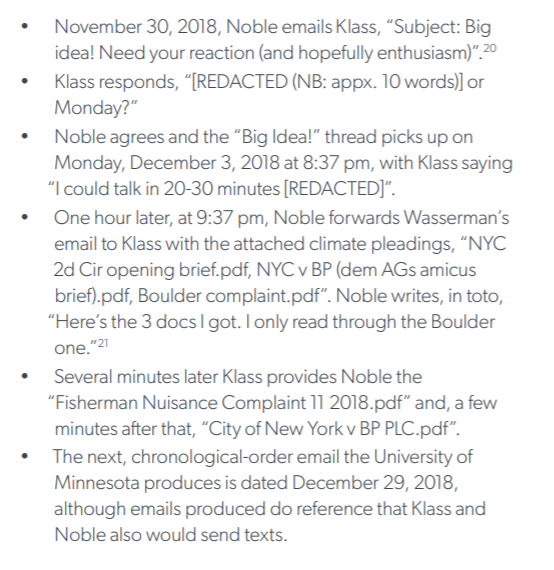
Later, public records requests showed that Noble CCI played an even larger role in orchestrating the lawsuit. Noble approached University of Minnesota Law School professor Alexandra Klass – who had moderated a forum on climate litigation with Ellison in 2019 – about writing a memo that justified such a lawsuit. The non-profit Government Accountability & Oversight documented the coordination in a report:
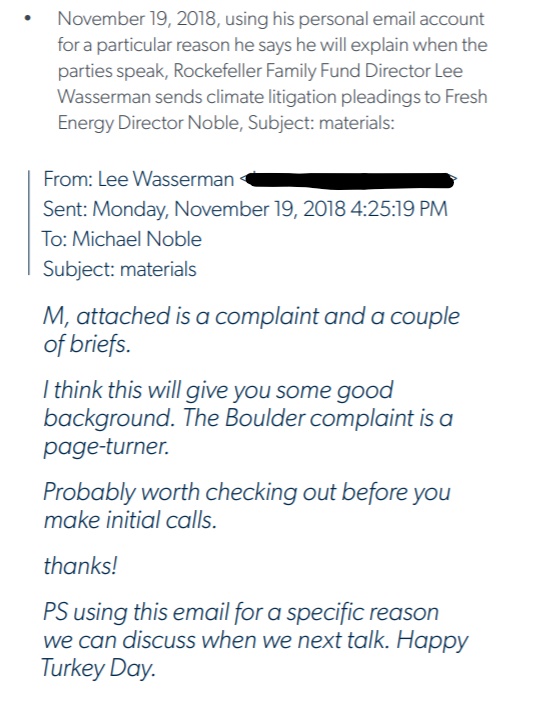
Noble then communicated with Lee Wasserman of the Rockefeller Family Fund, and told Klass about the plan to approach Ellison:
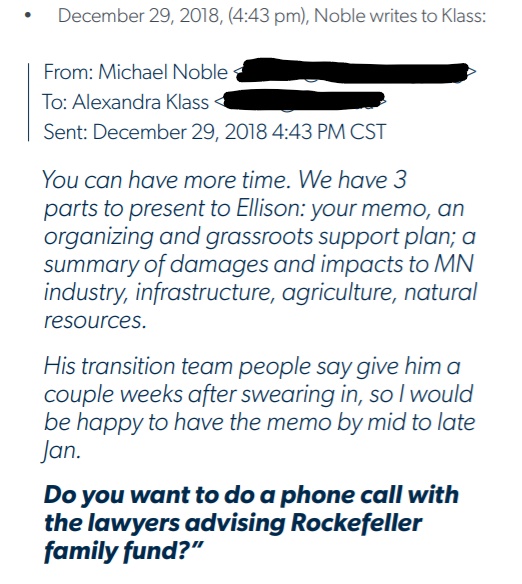
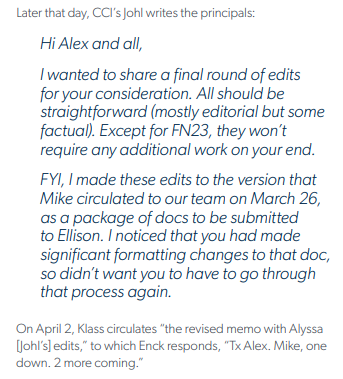
Later, Alyssa Johl from CCI provided legal edits to Klass’s memo:
And finally, Noble rounded up the entire group to go to talk to Ellison, including CCI, the Rockefellers, and himself:
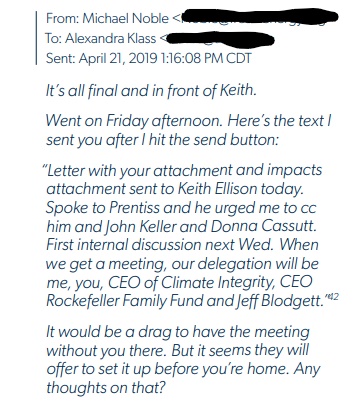
So, there it is, a helpful explainer showing how Ellison personally spoke with Fresh Energy, the Rockefeller Family Fund, and Center for Climate Integrity about his lawsuit, but never disclosed to the public everything that happened behind-the-scenes.