The increased use of natural gas in power generation has grown significantly, while at the same time, carbon intensity has fallen, new data from the U.S. Energy Information Administration (EIA) shows:
“From 2016 to 2020, the carbon intensity of U.S. power generation fell 18 percent, driven by a shift in the U.S. electricity generation mix away from coal and toward natural gas and renewables.” (emphasis added)
A more detailed look at EIA’s data – which Energy In Depth obtained earlier this year – showed that natural gas has been responsible for nearly double the power sector emissions reductions as non-carbon sources of power generation, which includes renewables and nuclear, over the last decade-plus.
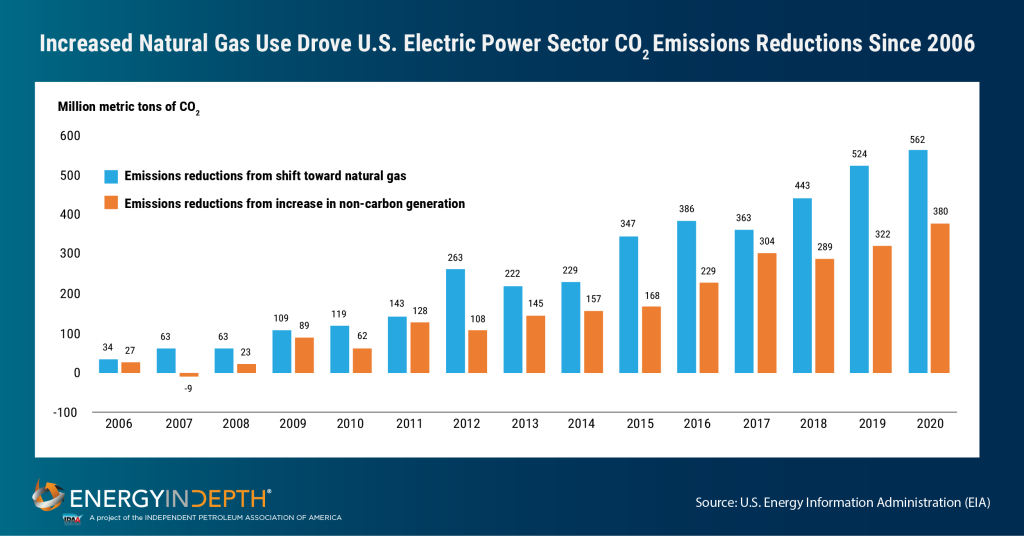
In fact, in 2020 alone, the shift to natural gas provided an emissions reduction of 562 million metric tons of CO2 (MMT CO2) – or the emissions equivalent of 150 coal-fired power plants operating for a year. That’s 182 MMT CO2e more than non-carbon sources of power generation in 2020.
The report further details that the vast majority of states across the country are experiencing lower emissions in the power generation sector, from the Marcellus and Utica Shale of West Virginia, Pennsylvania, and Ohio, to the Anadarko and Haynesville basins of Texas, Oklahoma, and Louisiana.
“All but seven U.S. states decreased their carbon intensity over that five-year period.”
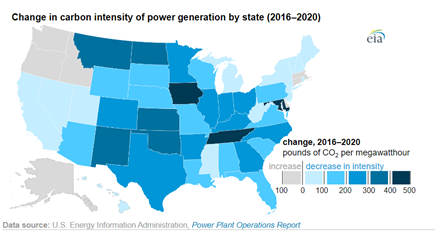
It’s worth nothing that several of the states that have not experienced lower carbon intensity are states that have opposed natural gas expansion. For example, Massachusetts, Connecticut, Washington and Oregon have all been at the center of natural gas bans and opposition to natural gas pipeline infrastructure.
The EIA data comes on the heels of another recent report that showed daily U.S. electricity generation from natural gas hit a record in mid-July. Across the lower 48 states, natural gas-fired power reached 6.37 million megawatt hours, surpassing the 2020 record and EIA’s short-term outlook for natural gas-fired generation.
Together, these trends underscore the important role natural gas plays in the energy transition. Natural gas is able to reliably meet energy demands while contributing to emissions goals – qualities that make it necessary to today’s energy mix, and a highly complementary energy source to renewables in the future.
Even John Kerry, U.S. Special Presidential Envoy for Climate, has acknowledged the climate benefits of natural gas. Earlier this year, Kerry wrote an op-ed in the Wall Street Journal where he endorsed policies that incentivize the use of natural gas in power generation:
“Natural gas is central to a smart and achievable policy to cut greenhouse-gas emissions today. In the near term, that means pairing with renewables to clean up electricity.” (emphasis added)
Energy in Depth has explored this symbiotic relationship between natural gas and renewables. Natural gas-fired power generation serves as the backbone for renewables’ operability, and given its resilience and flexibility, is considered one of the most versatile energy sources to support the intermittent nature of renewable energy.
The International Gas Union (IGU) notes:
“Natural gas is clearly the most effective partner for green energy, merely one of a number of qualities of natural gas that make it a pivotal element of the global energy mix today and tomorrow.”
We’ve seen an example of this much-needed stability in recent weeks when California was forced to issue a flex alert to conserve energy amidst rolling blackouts. In a power emergency, the state relied on natural gas to secure the grid and continue powering homes where renewables alone fell short.
Bottom Line: States across the country are proactively making progress on lowering carbon intensity in power generation, and natural gas is largely to thank. Continuing to utilize low-carbon natural gas for clean power is a critical piece of the energy transition puzzle that can’t be ignored in the short or long term.