The unprecedented switch to natural gas for power generation across the United States is not only reducing U.S. emissions, but also helping to save thousands of lives, according to new research from the Rhodium Group and University of California at San Diego.
The new reports provide critical context to any discussions about limiting energy development through fracking, the technique that has fueled the shale revolution and made this historic shift to natural gas use and clean air benefits possible.
U.S. Emissions Decline in 2019
Rhodium Group recently released its annual preliminary emissions estimate, finding that U.S. greenhouse gas emissions declined 2.1 percent in 2019. Emissions from the power sector, where natural gas has become the dominant fuel source, fell nearly 10 percent, which was “the biggest year-on-year drop in decades, and a significant change from a 1.2 percent increase in 2018,” according to the report.
As Rhodium Group explains:
“The switch from coal to natural gas and renewables in the electric power sector accounts for the majority of the progress the U.S. has made in reducing emissions over the past decade. This was particularly true last year.”
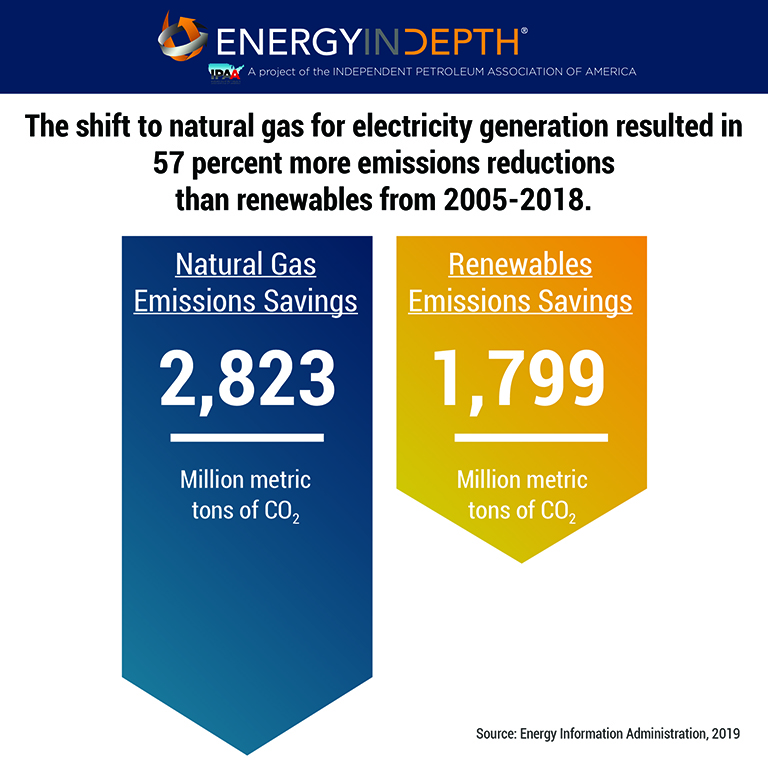
This is supported by U.S. Energy Information Administration data showing that natural gas leads all energy sources in emissions savings. Natural gas has reduced carbon emissions by 2.8 million metric tons since 2005 – a 57 percent greater reduction in emissions than renewables.
Using More Natural Gas Is Saving Lives
These emissions reductions are having far-reaching and positive impacts on health and the environment. A recent UC San Diego study found that the switch to natural gas for power generation from 2005 to 2016 “saved an estimated 26,610 lives and 570 million bushels of corn, soybeans and wheat in their immediate vicinities.”
According to the study, the closure of more than 334 coal-fired units coupled with the addition of 612 natural-gas units, along with improvements in emissions control technologies, “produced net reductions in SO2 and NOx of more than 80 percent and 60 percent, respectively.”
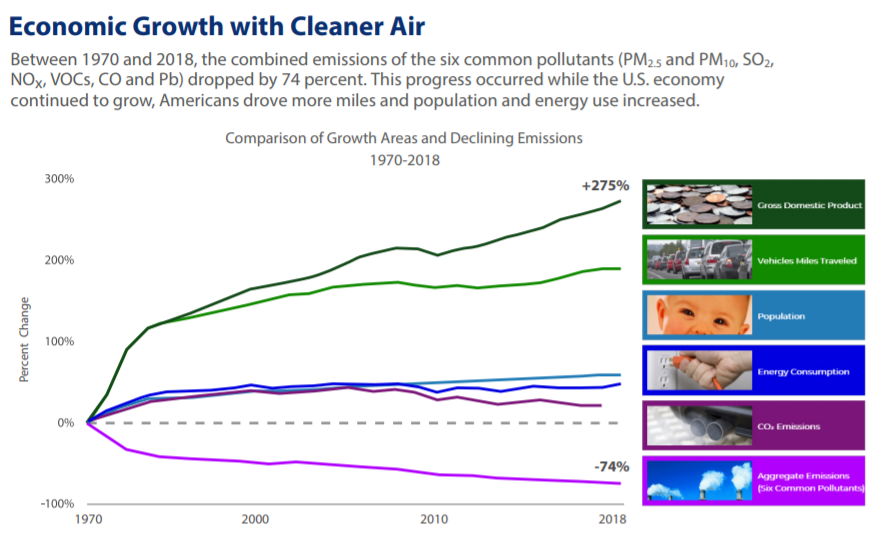
This is in line with findings in the Environmental Protection Agency’s 2019 Our Nation’s Air report, which showed that U.S. sulfur dioxide emissions fell 88 percent and nitrogen oxide emissions decreased 59 percent from 1990 to 2018. These reductions are significant, as both pollutants can cause significant respiratory issues and increase the formation of particulate matter (PM2.5) and, in the case of NOx, smog (ground level ozone).
Notably, natural gas isn’t just saving lives by reducing emissions. A 2019 National Bureau of Economic Research paper found that lower energy costs, made possible by the shale revolution, prevented thousands of winter deaths annually from 2000 to 2010:
“We find that lower heating prices reduce mortality in winter months. The estimated effect size implies that the drop in natural gas prices in the late 2000s, induced largely by the boom in shale gas production, averted 11,000 winter deaths per year in the U.S. We also find that the effect does not just represent short-run hastening of mortality.” (emphasis added)
—
“This effect size is large enough that it should not be ignored when assessing the net health effects of shale production of natural gas.” (emphasis added)
Conclusion
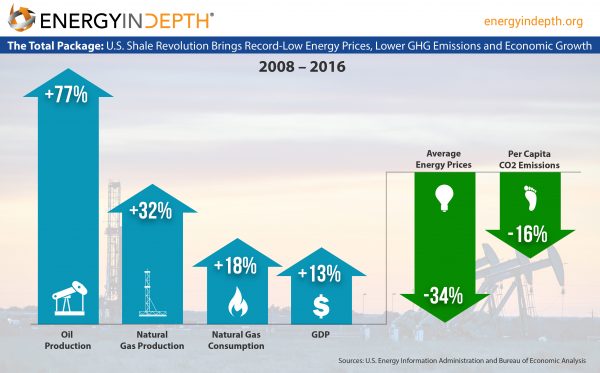
Innovation and advanced technologies have played a major role in the United States growing its economy, while also being a world leader in emissions reductions. And the oil and natural gas industry is at the forefront of those efforts, ensuring that Americans have an affordable and reliable energy supply. As American Petroleum Institute President Mike Sommers recently said:
“The nation with the largest and most innovative economy in the world runs on affordable and reliable energy, the majority of which comes from natural gas and oil. Our mission as an industry starts with meeting that rising demand and doing it responsibly. We are relentless in finding and producing affordable energy. And just as persistent in reducing our environmental footprint, improving safety technology, and decreasing emission rates. But we’re not finished.”