Emissions in the United States began to rise again in 2021 as the country began a slow recovery out of the COVID-19 pandemic following a historic drop amid widespread economic disruption in 2020, according to a new report from the consulting firm The Rhodium Group.
Comments from the report’s co-author make clear that the shale revolution and increased use of natural gas for power generation was a major driver of emissions reductions over the past ten years and the recent spike in emissions can be credited to the increased use of higher emitting fuels in 2020.
Yet, emissions are still below 2019 levels as the country deals with the rising and falling waves of the pandemic and its effects on economic growth. The report states:
“Despite the political and financial measures to support recovery in the US, 2021 was characterized by continued uncertainty as the country navigated a patchwork of COVID-19 prevention measures, access to vaccines, and the emergence of new variants. Consequently, the US economy—and production of greenhouse gas (GHG) emissions—remained below pre-pandemic levels. Based on preliminary data for 2021, Rhodium Group estimates that economy wide GHG emissions increased 6.2 percent relative to 2020, though emissions remained 5 percent below 2019 levels.” (emphasis added)
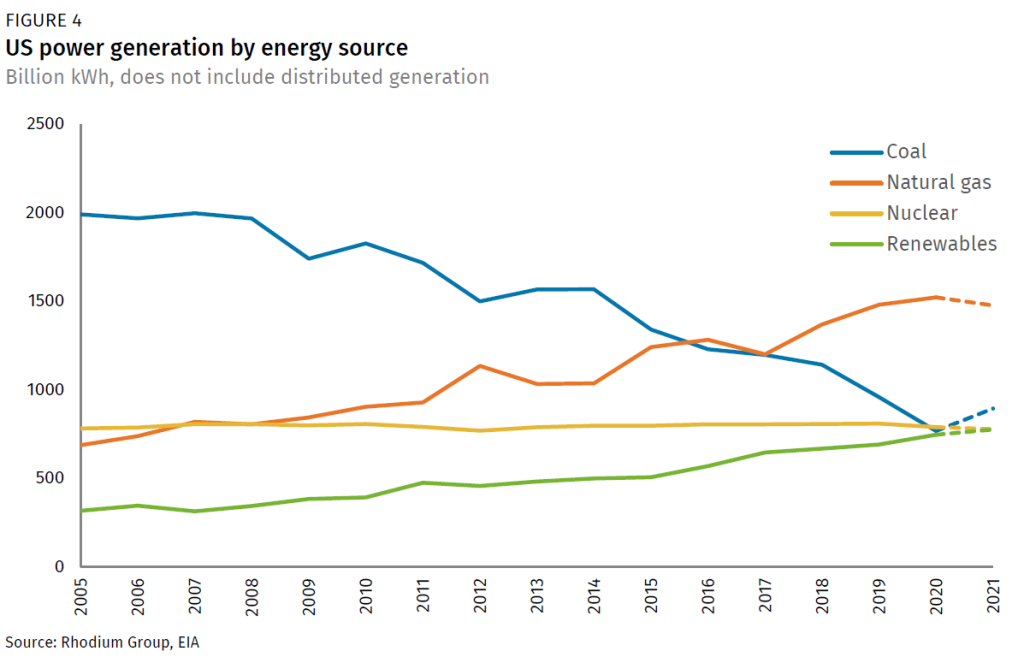
In the power generation sector – which Rhodium says accounts for a quarter of U.S. emissions – it was the first year that natural gas did not see increased generation, although coal and renewables did. As Rhodium explains:
“With only modest growth in overall electric power demand in 2021 (up 3 percent from 2020), the more robust growth in power sector GHG emissions was due to a sharp rise in coal generation, jumping 17 percent in 2021. This marks the first annual increase in coal generation since 2014, according to the US Energy Information Administration.”
The graph below illustrates coal’s bounce back tied together with falling generation from natural gas due to rising prices for that fuel.
Kate Larsen, a partner at the Rhodium Group and a co-author of the report said that the rise in emissions is “Largely a story about coal’s rebound” while stating that natural gas has played a critical role in lowering emissions during the last decade. As Larsen told Axios:
“I think that’s a sign that the fate of U.S. greenhouse gas emissions is largely in the hands of oil and gas producers because the market for natural gas is one of the primary drivers of coal’s decline, and of U.S. emission reductions over the last decade.”
The New York Times, covering the report, also noted the key role that natural gas has played in reducing emissions in recent years:
“In the years before the pandemic hit, America’s electric utilities had been retiring hundreds of coal plants, replacing them with cheaper and cleaner natural gas, wind, and solar power.”
While Larsen echoed the need for cleaner-burning natural gas:
“It really illustrates how much we’ve depended on cheap natural gas prices to keep coal in decline.”
Unfortunately, a strong natural gas sector in the United States has been undermined in recent years by government leaders and Keep It In The Ground groups, including the Biden administration’s illegal ban on leasing on federal lands, fringe politicians cheering on the loss of energy sector jobs, and activists trying to block new production and pipeline construction.