Using U.S. liquified natural gas (LNG) for power generation emits significantly less greenhouse gas emissions than coal in three primary markets, according to a new American Petroleum Institute study conducted with researchers at ICF International. The study concluded that U.S. LNG produces 50.5 percent fewer emissions on average when used for electricity generation in China, Germany and India.
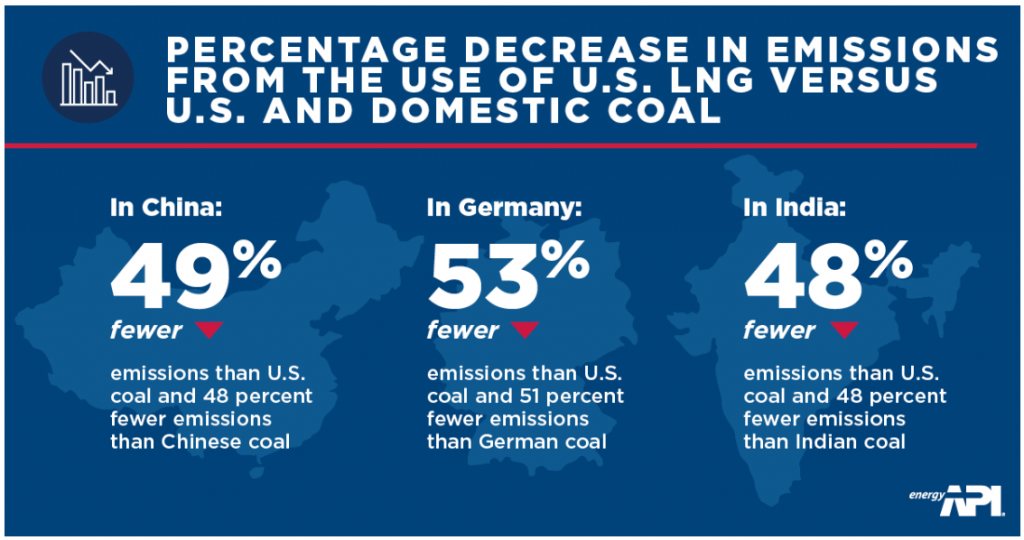
To add some context, along with the United States, China, Germany and India are ranked among the top five largest global economies. Naturally, these three economies also have a gargantuan energy demand to power their continuous economic growth, and also to provide affordable and reliable energy to their populations. Yet, coal is still the predominant source of power generation in these three countries, representing 66 percent, 74 percent and nearly 30 percent of power generation in China, India and Germany, respectively.
As API Director of Market Development Dustin Meyer said:
“This study underscores what we have known for quite some time – that U.S. natural gas is a far cleaner option than coal for electricity generation, especially in key markets in China, Germany and India.”
It is a fact that gas-fired electricity dominates the U.S. grid. Since 2005, coal-fired power generation has dropped by half in the United States. Unsurprisingly, and due to the shale revolution, natural gas quickly filled that spot and doubled its market share in the same period. This shift explains how the United States power sector achieved major emission reductions in such a short time, including meeting its climate targets 11 years ahead of schedule.

LNG ranked highest for power generation emissions reductions
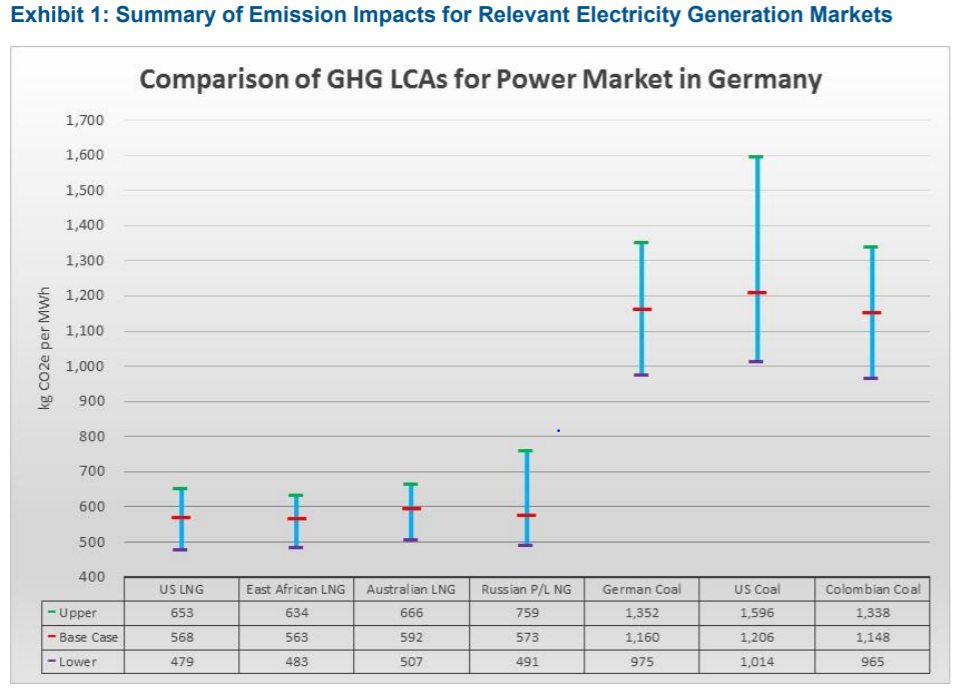
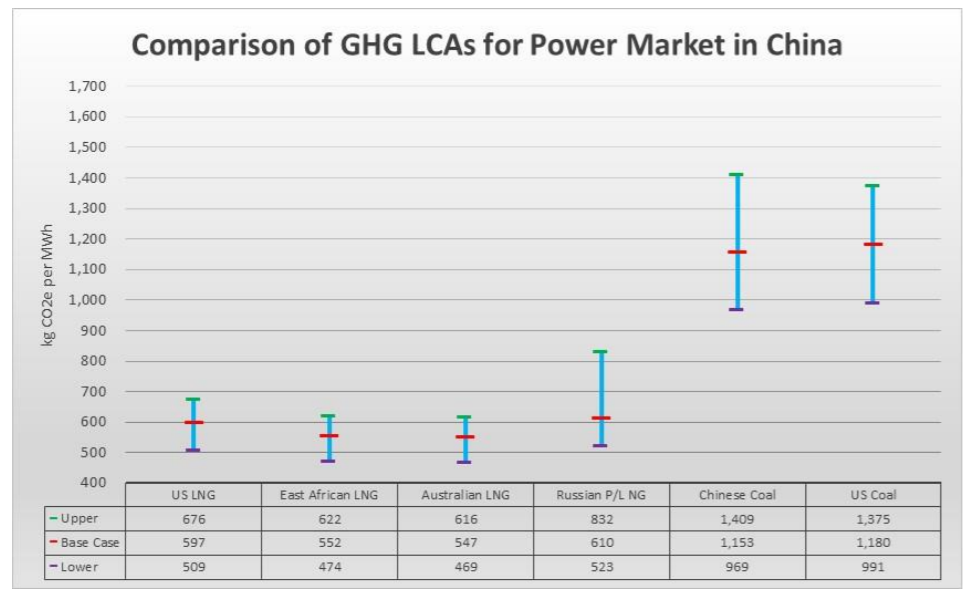
The API study calculated the life cycle – from production through the fuel’s use for power generation – GHG emissions of both domestic and U.S.-produced coal, as well as LNG from the United States, Australia and East Africa. For Germany and China, a comparison was also included for natural gas delivered via pipeline from Russia.
Unsurprisingly, natural gas outperformed coal in its emission reduction impact, including when the coal is locally sourced with shorter transportation.
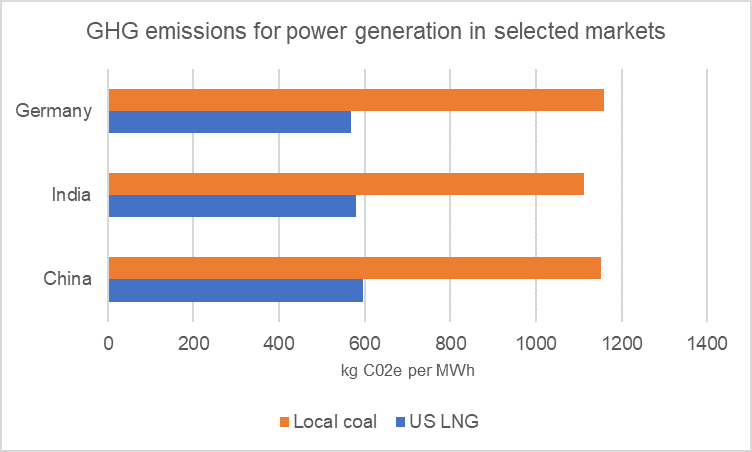
Source: based on data from API study
As the following charts show, U.S. LNG was also found to produce less life cycle emissions than natural gas via pipeline in both Germany and China – albeit by much smaller margins.
Natural gas is needed to continue ensure greater emission reductions from power generation
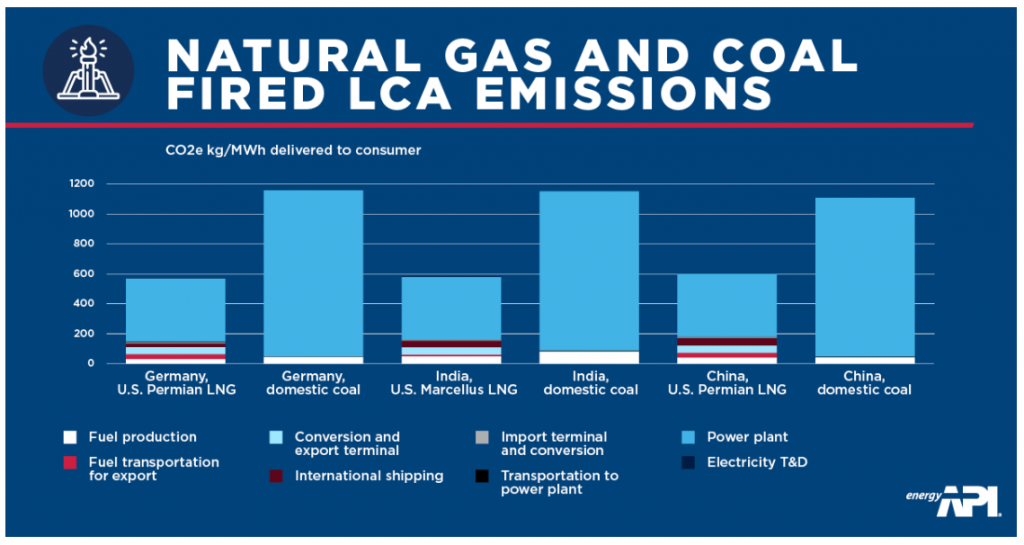
The study also conducted a detailed analysis of the GHG emissions from each phase in the supply chains for LNG and coal, identifying which phase generated the most GHG emissions. This study evaluated the entire value chain from the extraction phase to the transportation and distribution of electricity to consumers. It concluded that the phase that caused the most fugitive emissions was during power plant operations, particularly in the case of coal. In fact, 92 percent of the total GHG emissions derived from coal-based electricity in China resulted from this phase.
In contrast, when using U.S. LNG, GHG emissions are 20 percent lower during the power plant operation stage. Hence, natural gas continues providing the greatest emission reduction results for energy production.
U.S. LNG will lead the energy transition worldwide
As the use of LNG continues to expand, further cementing its position as the preferred power source, U.S. LNG has the potential to drive the global energy transition forward and help other countries to clean their power grids too. As Meyer explains:
“U.S. LNG exports can help accelerate environmental progress across the globe, enabling nations to transition to cleaner natural gas to reduce emissions and address the global risks of climate change.”
Moreover, the United States is ready to accept this challenge. According to the API study, U.S. liquefaction capacity is expected to add 60 million metric tons per year by 2025. This is equivalent to 68 percent more than the expected liquefaction capacity globally.
The Energy Information Administration estimates global energy demand to increase 1.2 percent annually through 2040, and as this report demonstrates, U.S. LNG is poised and ready to meet the world’s needs.