On Friday, U.S. District Court Judge Michael J. Truncale denied California Attorney General Rob Bonta’s motion to dismiss in a defamation lawsuit filed by ExxonMobil, giving the company the opportunity to finally fight back against Bonta attacking advanced recycling technologies. The order also gave the green light to intervene for three Texas municipalities and one Texas county, allowing them to combat potential damages resulting from California’s defamation for their respective communities.
The company filed the lawsuit after Bonta decided to take his anti-industry playbook to a new arena and target plastics recycling with a lawsuit in September 2024.
Filed in coordination with another suit by four environmental NGOs using parallel claims, the plastics lawsuit mirrored unsuccessful climate lawsuits across the country. The “recycled” claims lean on the same weak legal theories connecting public nuisance and deception to the operations of major U.S. energy companies.
After facing consistent losses in climate-focused cases, the same network of anti-industry groups and wealthy foundations has expanded its efforts towards attacking the petrochemical and plastics industry. California – a state who readily attacks oil and gas – has welcomed the opportunity to pursue legal action against another critical industry despite their legal arguments relying on shaky ground. Luckily, just like in climate, courts are beginning to see the cracks in these far-fetched legal theories.
In Texas, as shown on Friday, it appears California and Bonta have hit a roadblock. As the court order describes, the company details how AG Bonta emailed defamatory comments about the company and information about his lawsuit to Texas residents and conveniently included a campaign contribution link in the same email. Such conduct indicates the Court has specific personal jurisdiction over Bonta, as the order states:
“If Bonta wants to fundraise in Texas, he can answer to courts in Texas…There is nothing unfair about specific personal jurisdiction here.”
One of the other key parts of Bonta’s motion to dismiss is his defense under Eleventh Amendment Immunity, which gives states, state agencies, and state officials acting in their official capacities immunity from lawsuits filed by citizens of other states. Alongside Bonta’s failure to quality for official immunity, Judge Truncale makes it clear his position as Attorney General does not protect him from the consequences of defamation:
“Because it is not clear Bonta was acting in his official capacity, the Court cannot grant his Eleventh Amendment arguments on that ground…California is not the target of this lawsuit and the Eleventh Amendment does not apply. This case concerns an individual’s behavior—specifically actions for which the Court denied official immunity. Additionally, this case is not aimed at changing the way California operates, compelling California to act, or accomplishing a California policy change…Under these circumstances Eleventh Amendment immunity is not implicated.”
Despite repeated failures in the state, from punitive energy policies causing increased consumer costs to the failure of the climate litigation campaign, the state’s leaders cannot seem to help themselves from continuing to attack oil and gas companies. It seems that attitude won’t fly in Texas.
Newsom Can’t Pick A Side
In recent months, California Governor Gavin Newsom has been attempting to distance himself from a long history of climate policies that ignored economic realities. As he likely considers a presidential run, the reversal to finally considering consumer costs is not all that surprising. For example, Newsom even went as far as to sign a legislative package that enabled more oil and natural gas drilling in Kern County.
As Energy in Depth has previously analyzed, Newsom is not the only state leader backtracking on climate policies, as energy and high costs are top of mind for voters around the country.
With this new approach, Newsom has notably refrained from promoting his state’s litigation against U.S. energy companies, a clear shift from his earlier backing of the legal attacks. After the initial filing of the plastics lawsuit, Bonta made sure to tout the governor’s support:
“The governor is aware of this case and supportive, and you need only look at his record when it comes to holding the fossil fuel industry accountable to know that this is something he would on the natural be supportive of. So, while he’s not on this call as part of this announcement, he and his office and the relevant state agencies are aware, and they are supportive.”
Today, however, that earlier rhetoric has collided with the reality of high prices and tightening fuel supplies, leaving Newsom to navigate the consequences of frivolous lawsuits that have driven energy producers from the state.
The clearest example came during Climate Week NYC 2025. Throughout the week, Newsom kept quiet about both climate and plastics litigation. His Attorney General missed the memo and instead used the opportunity to pledge more lawsuits.
More recently, during a panel at the Munich Security Conference, titled “Playing With Fire: The Need for Decisive Climate Action,” Newsom once again declined to mention his state’s litigation against energy companies. However, he still made sure to villainize the industry:
“Well, better people better buck up—wake up. I mean, I made some pretty aggressive comments in Davos. I think I handed out knee pads on stage for, you know, corporate leaders—sold-out universities—you know, law firms in my country that are selling out. You just got to call this stuff out. Look: the polluted heart of the climate crisis is big oil. Period. Full stop. That’s what this is all about. That’s where the politics—that’s where the timidity—comes from.”
The commentary is not surprising coming from Newsom, who up until recently, has built a political platform on attacking oil and gas companies. However, Newsom is taking a pass on easy opportunities to tout the aggressive actions California has taken against oil and gas companies in the courts, apparently only now realizing that it flies in the face of affordable energy.
Foreign Billionaire Funding Another Industry Attack
Newsom’s appearance at Munich is noteworthy for another reason – the man sitting just a few chairs away. Sharing the stage with California’s Governor was none other than Andrew Forrest, the Australian billionaire and the executive chairman of mining giant Fortescue.
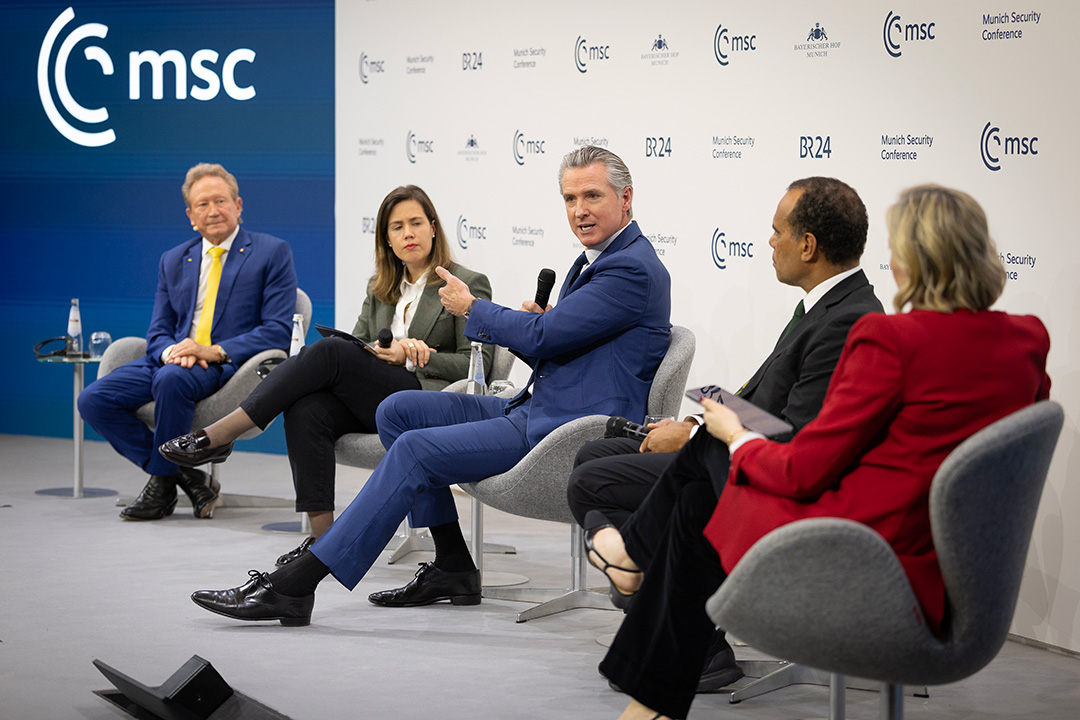
Source: California Governor Gavin Newsom
So, why is an Australian billionaire sitting on a climate panel with Gov. Newsom?
The answer is something that has gone under the radar, but radically shifts the context of California’s plastic lawsuits.
Forrest, through his Minderoo Foundation, is funding the law firm Cotchett, Pitre & McCarthy, who is representing the NGOs in the parallel California plastics case. According to a FARA filing, Minderoo “owns and controls” the Intergenerational Environmental Justice Fund (IEJF) which is the organization that retained the law firm.
With Forrest’s involvement, there’s no question that California’s anti-industry plastics recycling lawsuits are another way for foreign actors to infiltrate U.S. policy through the courts, with billionaires filtering their money through nonprofits.
Interestingly, despite Newsom and Forrest both being involved in one of the two plastics recycling lawsuits in California – the Attorney General’s and the NGOs’ respectively – and the panel being about climate change, neither spoke about the cases in Munich.
Bottom line: The recent order from the U.S. District Court in Beaumont, Texas, sends a clear message: you cannot constantly attack a company, especially as a government official, and then expect to never answer for your actions. As California finally faces the consequences of years of attacking oil and gas companies, its leaders are finally having to answer in both the courtroom and to their voters.