Energy companies targeted by public nuisance lawsuits recently asked the U.S. Ninth Circuit Court of Appeals to stay a mandate that would allow two California municipalities’ cases to proceed in state court, explaining that they plan to file a petition before the United States Supreme Court that will “raise a substantial question that has divided the circuits.” It will be the companies’ second petition requesting SCOTUS to weigh in on a technical legal issue that has recently determined in which court system these cases can proceed: the scope of appellate review.
To quickly recap, these cases have, for the most part, originated in state court. The energy companies pushed them to federal district court, which ultimately sent them back to the state level. The companies then appealed these remand orders to the appropriate U.S. Circuit Courts.
Even though the energy companies removed the cases to federal court on several separate jurisdictional grounds, three circuit courts recently allowed them to move forward in state court after considering (and rejecting) just one of the removal theories.
These courts have held that the district court’s remand order is reviewable only to the extent it addresses whether removal was proper under “federal officer removal” – a statute that permits a defendant to litigate claims in federal court whenever the activity of the defendant of concern in a lawsuit was at the direction of a United States agency or officer.
The companies, meanwhile, argue that the federal officer removal statute authorizes appellate review of the entire remand order. Therefore, because they invoked the statute in their motions for removal, the circuit courts should have considered all of their other arguments as well – a position they’re taking to the U.S. Supreme Court.
SCOTUS, Do You Copy?
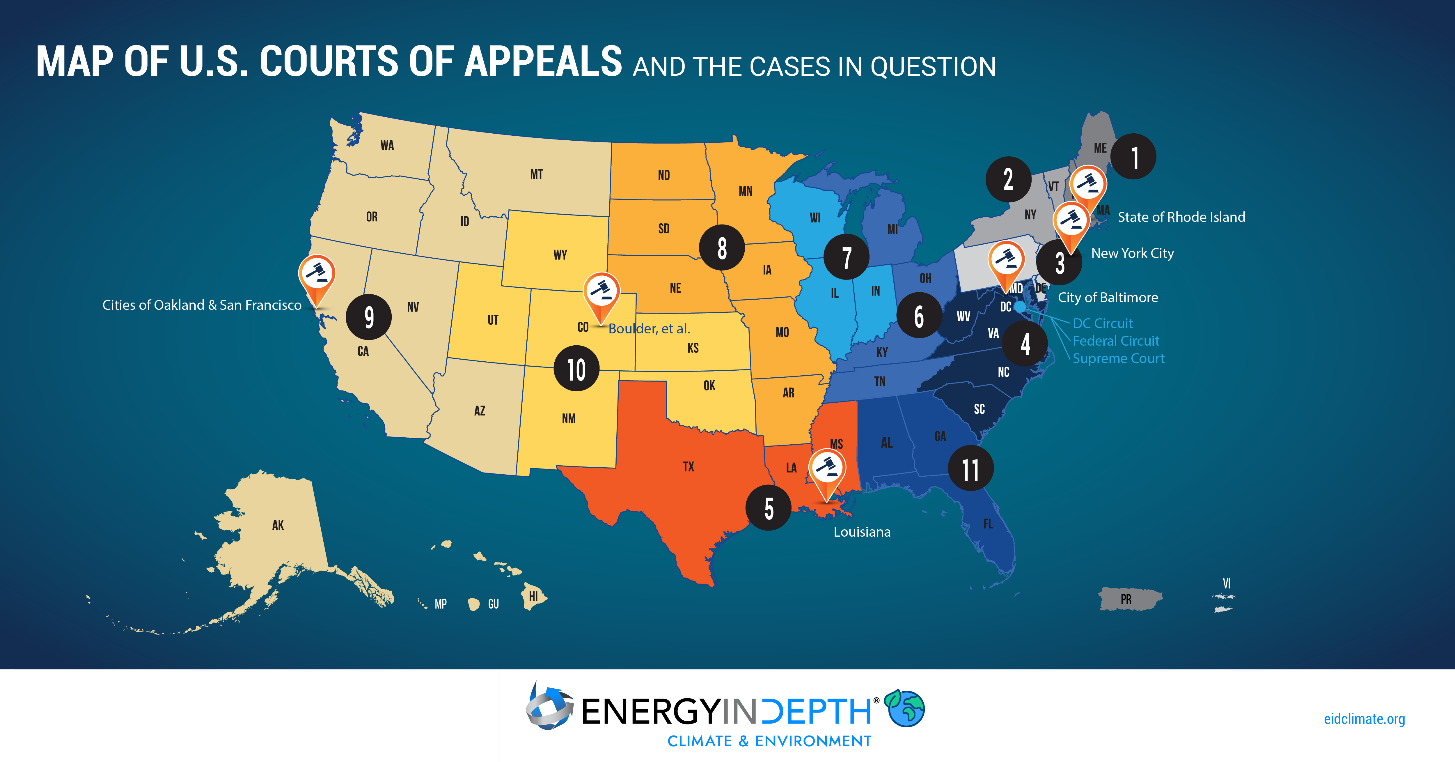
The confusion began in March when the U.S. Fourth Circuit Court of Appeals ruled that Baltimore’s climate lawsuit belonged in state court. In limiting the scope of its review to federal officer removal, the Fourth Circuit split with the Seventh Circuit, which holds that appellate courts may consider the entire remand order on review. The Fifth and Sixth Circuits, meanwhile, have ruled inconsistently when it comes to the issue.
Later in March, the companies petitioned SCOTUS to resolve the differing interpretations of the issue, calling it an “entrenched conflict” among the circuit courts.
Since then, finding their hands tied by the Fourth Circuit’s ruling, the Ninth and Tenth Circuits have also remanded municipal-led climate lawsuits originating in California and Colorado, respectively, back to state courts after ruling on the sole issue of federal officer removal.
In a brief filed before SCOTUS, the companies explained that the Ninth Circuit judges said they were bound by precedent, while the Tenth Circuit repeatedly acknowledged the “disagreement among the courts of appeals” and called it a “close question” – heightening the need for SCOTUS intervention:
“Five different courts of appeals have recognized the conflict over the last three years alone; two of those courts endorsed petitioner’s interpretation of [the federal law governing removal], but three others declined to follow it, mostly relying on conclusory holdings in prior circuit precedent. And of the two regional courts of appeals that had not spoken to the question at the time of the petition, one has since adopted respondent’s interpretation, and the other is poised to address the question in a currently pending appeal. Given the recent case law supporting petitioner’s interpretation and the overwhelming number of circuits that have spoken to the issue, only this Court can realistically resolve the conflict.” (emphasis added)
The companies plan on submitting another petition before the Supreme Court regarding the issue of the scope of appellate review, as they told the Ninth Circuit in a motion requesting the court stay its recent decision remanding San Mateo County and other California municipalities’ lawsuits to state court:
“Absent a stay, these six cases may be remanded to four different California state courts based on the Court’s conclusion that removal was not proper under [federal officer removal], even though the Court has not considered whether removal was proper on any of the other grounds presented in Defendants’ notice of removal.”
More circuits are anticipated to make significant rulings in several other climate lawsuits in the near future as well. The Second Circuit’s ruling on New York City’s appeal of its dismissed climate lawsuit is imminent, while the First Circuit is also reviewing the remand of Rhode Island’s climate change lawsuit back to state court. The Fifth Circuit recently affirmed a remand order for coastal erosion lawsuits targeting energy companies brought by several Louisiana parishes that are nearly a decade old. The decision, however, was based solely on the timeliness of a procedural issue, not to the merits of the case or the substantive interpretation of federal officer removal.
Reminder: This Issue Has Nothing to Do with the Merits of These Cases
These circuit court rulings are purely procedural and are not passing judgement on the climate lawsuits’ actual merits. In fact, every court that has had an opportunity to consider the cases’ merits – Judge William Alsup in Oakland and Judge John Keenan in New York – has dismissed these cases because they involve issues that should be resolved by the political branches of government and not the judiciary, as noted by the energy companies in a recent filing in one of the cases:
“Plaintiffs allege that Defendants’ global extraction of fossil fuels—and billions of third parties’ global combustion of those fuels—has contributed to global climate change. Every court to reach the merits of these claims has soundly rejected them because they intrude on the prerogatives of the federal Executive and Legislative Branches.” (bolding added)
Nevertheless, it’s important to remember that these nuanced procedural legal questions, while not making any determination of the legitimacy of the plaintiffs’ claims, could have a significant impact on how these lawsuits progress.