After four years of investigation and 11 days of trial testimony, the famed New York “Exxon Knew” trial will come to an end tomorrow following brief closing statements from the two parties. What’s clear among reasonable observers is that the NYAG failed “to produce any definitive evidence that the oil company intentionally misled investors about how it accounted for climate-change risks.” Indeed, New York Supreme Court Justice Barry Ostrager himself became increasingly skeptical of the State’s case in the trial’s early days, even threatening to rest their case prematurely, after just the first week of what the Wall Street Journal editorial board deemed a “show trial.”
So, as the trial comes to a close tomorrow, we at Energy In Depth (and everyone else paying attention to this dumpster fire) can’t help but ask the NYAG:
1. Were there no accounting majors in the AG’s office in the last four years?
The NYAG’s case is based almost exclusively on ExxonMobil’s use of two separate and distinct costs the company uses to account for climate change regulations. The first is the proxy cost of carbon, which is a global assessment of the impact that current and potential future climate policies may have on the demand for (and therefore, price of) energy. The second is the GHG (greenhouse gas) cost, which is applied as an expense, where appropriate, to account for the cost of climate-related regulations on specific ExxonMobil projects in specific jurisdictions.
ExxonMobil’s use of the two costs is not in dispute, and both have been disclosed to investors on many occasions. What is in dispute is the NYAG’s claim that the company told investors it applied one cost, but actually applied a lower cost internally. The absurdity of the allegation was highlighted by Ted Wells, counsel for ExxonMobil, during his opening statement:
“This notion that we would be using lower costs than are appropriate, it makes no sense. We would not be in the business of cheating ourselves.”
Document after document, witness after witness, it became more and more clear that the company had a robust, consistently-applied approach to implementing these costs in a manner consistent with what they told investors. No evidence to the contrary surfaced during or before trial.
2. Where was the evidence of the “longstanding fraudulent scheme” and “Potemkin village” the AG outlined in her complaint?
ExxonMobil produced four million pages of internal company records and countless employees for deposition in the four years after then-NYAG Schneiderman commenced the investigation into the company. On the eve of closing statements, following 11 days of trial, observers and participants alike are wondering: where’s the smoking gun?
As a Bloomberg story explained “what was originally advertised as a frontal assault on Big Oil for fueling the planetary climate crisis has—over the years—been transformed into the kind of hair-hurting corporate accounting lawsuit more common to the courthouses just a few subway stops north of Wall Street.” As that outlet noted in a later piece, “none of the documents discussed at trial so far appeared to show an intentional scheme like the one New York Attorney General Letitia James alleges.”
In the end, the NYAG’s office couldn’t produce a single witness or shred of evidence that would come even remotely close to supporting her scurrilous claims.
3. Where exactly were all the “misled” ExxonMobil investors and equity analysts?
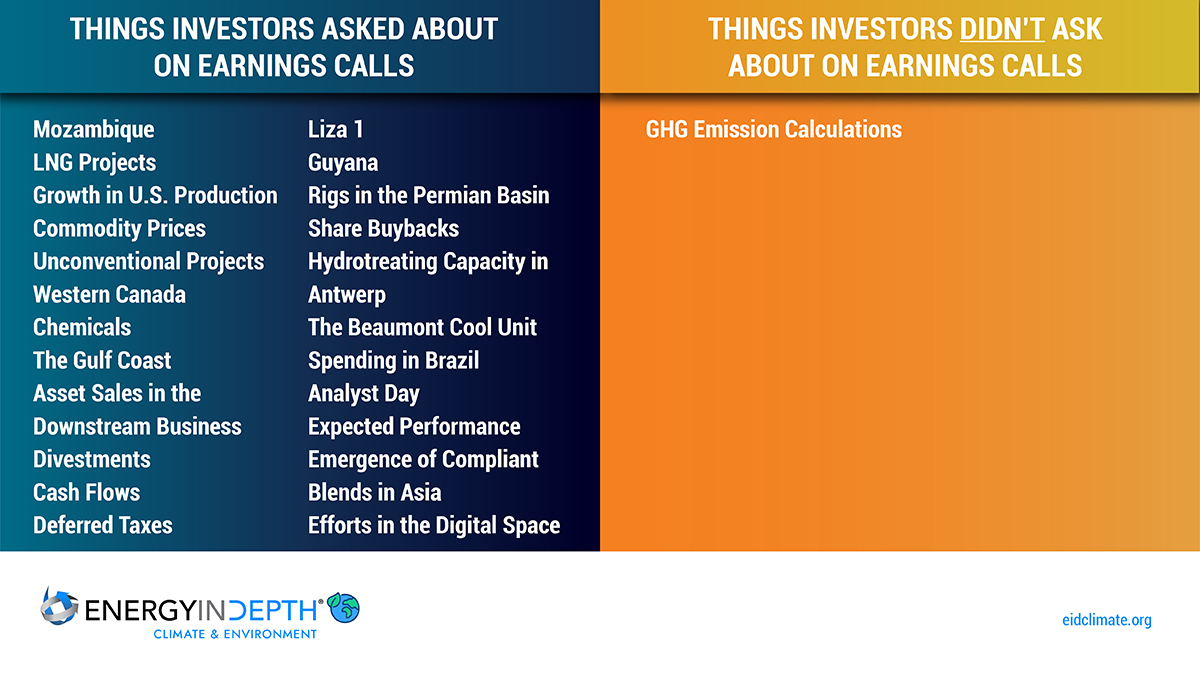
Perhaps one of the most striking components of the farcical case against ExxonMobil was the number of ExxonMobil investors and professional equity analysts called to testify that said they were misled by the company. That number was zero. Nada. None. As the world’s largest publicly-traded oil & gas company, ExxonMobil’s investor list includes many (if not most) of the world’s largest institutional investors and tens of thousands of retail investors. It is scrutinized regularly by approximately thirty professional equities research analysts. In dozens of earnings calls, no investors or analysts ever asked about how the company calculates and applies GHG costs.
So, in a case where the central question is whether the company misled investors, the NYAG failed to offer up a single investor that claimed to be misled. On the other hand, when Marketplace asked Mark Stoeckle, CEO of Adams Funds and an ExxonMobil investor, about the NYAG’s claim that ExxonMobil defrauded its investors by utilizing two costs, Stoeckle replied, “I’m not sure that’s fraud. Sounds like good business judgment.”
4. You call those expert witnesses?
The NYAG’s “expert” witnesses were anything but, as opposing counsel thoroughly impeached their credibility over the course of several days. One “expert” hired by the NYAG (at a potential cost to taxpayers of $330,000) was hired to examine the company’s internal investment models, but admitted that he may have confused the numbers in ExxonMobil’s spreadsheets because he didn’t understand the models. The State’s other expert witness fared little better (this one cost taxpayers $500,000 and charged $1,050 an hour), as his rambling answers and repeated misstatements failed to prove that ExxonMobil had misled its investors.
Reporters in the room seemed wholly unimpressed by these costly “experts.”
#Shade intensifies at the #Exxon trial in #NewYork
Defense: You’re not an expert in oil and gas demand, correct?
Expert witness: No that’s not my area of expertise.
Defense: Ok, let’s stay within the subjects you think you’re an expert in.#OOTT #ClimateChange $XOM
— Frans Koster (@FransLKoster) November 1, 2019
5. You call this “material” with a straight face!?
Putting aside the total lack of evidence outlined above, the NYAG made matters worse for themselves by making the extraordinary leap of a claim that investors were somehow shorted between $476 million and $1.6 billion. The NYAG’s office relied on some tortured logic and analyses from their two “expert” witnesses to make a case that investors were impacted.
But Allen Farrell, a Harvard Law School professor and Compass Lexecon economist called by ExxonMobil to testify, tore Eli Bartov’s and Peter Boukouzis’ testimony apart, calling the NYAG’s assumptions and economic calculations “meaningless.” Ferrell also said Bartov failed to use basic controls in his analysis of ExxonMobil’s share-price movements and said Boukouzis incorrectly cited stock movements that were not statistically significant.
Farrell accused the NYAG of employing “circular” logic for claiming that its own investigation was responsible for drops in the company’s stock price. “You don’t shoot the arrow and then draw a bulls-eye around it,” Ferrell said in court today.
6. Are you thanking your lucky stars the entire trial was not televised?
Activists made breathless proclamations in the lead-up to the show in NY, even claiming this would be the “trial of the century” and comparing it to the takedown of Al Capone. Needless to say, such claims could not have been more detached from reality. Justice Ostrager was unimpressed, repeatedly critiquing the State’s “agonizing repetitious questioning” and suggesting that the State was wasting the court’s time.
In addition to the NYAG’s repetitive questioning, the State struggled to even explain the basis for the questions it posed to its own witnesses, prompting Justice Ostrager at one point to interject:
THE COURT: Mr. Zweig, we are going to have to start over. Because you have a expert witness here; he is testifying with respect to hypotheticals; hypothetical assumptions that you have asked him to make. So, for example, if pigs had wings they could fly. So, in order for me to understand his testimony, I need to understand the assumptions that he was making in order to reach his conclusions. His conclusions without understanding the basis of his assumptions is of no assistance to the court whatsoever…
THE COURT: This isn’t a teaching exercise here. This is an important trial.
Bonus Question for Maura Healey: How do you feel about your case having watched New York’s implode?
Massachusetts Attorney General Maura Healey announced that she intended to sue ExxonMobil on similar charges before New York’s trial began, filing her complaint shortly thereafter. You have to wonder if she regrets that decision after watching New York’s argument crumble before her eyes.
The deck is stacked against Healey. New York’s laws are more powerful than hers, and New York received over four million pages of internal company documents going back four decades, deposed employees, and took four years to build its case – only to get egg on its face in the courtroom. Healey has not received a single document from ExxonMobil, has not interviewed a single employee, and has had her investigation tied up in court for over three years. Not to mention that she’s still singing to the “Exxon Knew” hymnal long after New York and others have moved on.
Conclusion
In the end, after four years of investigation, four million documents, and three different Attorney Generals, the NYAG’s office failed to provide a credible witness, no smoking gun, and no materiality. In other words, the case might just be best described as “a show about nothing,” just not nearly as funny.