Massachusetts Attorney General Maura Healey’s climate lawsuit faces yet another challenge since her investigation began more than four years ago, with a March 12 hearing putting the spotlight on the attorney general’s politically motivated case and extensive coordination with activist groups.
The court will hear arguments on two motions filed by ExxonMobil last summer but only made public in December 2020. The filings seek to dismiss the lawsuit for its flagrant constitutional violations and failure to state a claim in support of the Massachusetts attorney general’s consumer and investor deception allegations.
The Hearing: A Breakdown
The first matter at hand is ExxonMobil’s motion to dismiss, in which the company argues that Massachusetts’ case should be thrown out for several reasons, including a lack of personal jurisdiction, Healey’s allegations being based on a difference of opinion between her and the company concerning the role fossil fuels will play in the future, and baseless claims of “greenwashing.” Specifically, in its motion, the company rejects Healey’s consumer deception charges, arguing they are yet another way for the attorney general to compel ExxonMobil’s speech through its marketing practices:
“[Massachusetts’ consumer protection law] imposes only a duty ‘to disclose material facts known to a party at the time of a transaction.’ … It does not impose liability for failing to disclose a mere ‘suspicion or a likelihood, rather than knowledge.’ And it certainly does not impose an obligation to adopt and parrot the concerns the Attorney General might have about potential climate-related risks.” (emphasis added)
The court will also hear another motion which seeks to dismiss Massachusetts’ lawsuit under the state’s anti-SLAPP (strategic litigation against public participation) statute. In the motion, ExxonMobil argues that Healey’s case infringes on its First Amendment rights by obstructing the company’s ability to petition policy makers and the general public:
“The Office of the Attorney General for the Commonwealth of Massachusetts is at the forefront of an effort to cleanse the public square of political opposition it believes has ‘delay[ed] meaningful action to address climate change.’ … Those, like ExxonMobil, who decline to parrot the Attorney General’s call for an immediate transition to renewable energy are not simply diverse viewpoints in a public debate with state, federal, and global policy implications, but targets who must be silenced through ‘lawfare.’” (emphasis added)
These motions are the latest hurdle for the Massachusetts attorney general, who has faced numerous challenges since first launching her investigation into ExxonMobil in 2016, and subsequently filing the lawsuit in October 2019. Over these several years, Healey has struggled to make a compelling case for her crusade against one of the world’s largest energy companies, even after shifting the focus of the case following the New York attorney general’s loss in a curiously similar lawsuit in 2019.
As the next hurdle for this case approaches, EID Climate reviews the key developments in the Massachusetts attorney general’s climate lawsuit thus far and the many challenges it has faced over the past several years.
It All Goes Back To La Jolla and An Attorneys General Coalition
The Massachusetts attorney general’s case – and the modern-day climate litigation playbook overall – can be traced back to the infamous La Jolla conference in 2012. It was at this conference where activists, lawyers, and academics gathered to plot out the legal, political, and PR strategies needed to drive a wave of climate lawsuits against energy companies.
One of the key developments from this conference was the decision that recruiting “a single sympathetic attorney general” would be a key goal of the climate litigation campaign. To that end, activists found their sympathetic chief enforcement officer in then-New York Attorney General Eric Schneiderman, who launched the first climate change investigation in 2015. Schneiderman’s recruitment seemed to pay dividends when, in 2016, he held a press conference with former Vice President Al Gore and sixteen other state attorneys generals to announce the “AGs United for Clean Power” coalition. It was here when the Massachusetts attorney general announced her own climate change investigation into ExxonMobil.
At that press conference, Healey seemingly already knew how her investigation would result before it even started:
“And it appears certainly, that certain companies, certain industries may not have told the whole story, leading many to doubt whether climate change is real, to misunderstand and misapprehend the catastrophic nature of its impacts. Fossil fuel companies that deceived investors and consumers about the dangers of climate change should be, must be held accountable.”
That Healey made such a confident statement regarding the very question that her investigation was allegedly launched to give credence to the idea that her pursuit of the fossil fuel industry has been political from the beginning.
But these attorneys general were not acting alone, as activists and lawyers who hosted and participated in the La Jolla conference met with attorneys general offices to sell them on pursuing litigation against energy companies. Importantly, many of the same state attorneys general who attended the March 2016 press conference also signed a Common Interest Agreement to keep their legal strategy secret and hide their conversations about climate change litigation from the public. Reuters called it a “previously unknown level of coordination with outside advisers” before the arrangement was revealed through an open records request.
Support from Activists, Plaintiffs’ Attorneys, and Paid-For Legal Fellows
The Massachusetts attorney general, an elected public official running a taxpayer-funded office to carry out law enforcement actions, has regularly benefitted from an array of various individuals and organizations in the private sector.
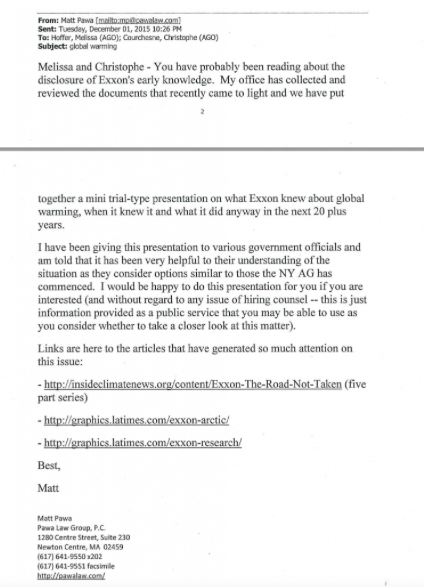
Directly before the 2016 press conference, the state attorneys general coalition was briefed by Matt Pawa, the plaintiffs’ lawyer who helped plan the litigation strategy at La Jolla and who went on to serve as outside counsel on behalf of San Francisco and Oakland, New York City and King County when those lawsuits were filed in 2017 and 2018. Pawa was joined in that briefing by Peter Frumhoff from the Union of Concerned Scientists, another key activist group at La Jolla and in the climate litigation campaign.
Shortly after the press conference, The Wall Street Journal contacted Pawa, asking about his briefing with Healey and the other state attorneys general. Before going back to the outlet, Pawa consulted with a top official with the New York attorney general’s office, who advised him, “My ask is if you speak to the reporter, to not confirm that you attended or otherwise discuss the event.” (emphasis added)
Even before the press conference, Pawa was building his relationship with the Massachusetts attorney general’s office, presenting his strategy for climate litigation to officials there in January 2016. A few months later, the Union of Concerned Scientists hosted a “secret meeting at Harvard” to present its “Potential State Causes of Action Against Major Carbon Producers” where five officials from Healey’s office were in attendance. That meeting aimed to “share legal and scientific information having an important bearing on potential investigations and lawsuits.” Several activists presented at that meeting, including UCS’s Peter Frumhoff and Harvard professor Naomi Oreskes, both who helped lead the La Jolla conference.
In 2017, during the climate march in Washington, D.C., Healey took a photo with 350.org co-founder Bill McKibben. McKibben has long advocated for states and municipalities to file climate lawsuits and his 350.org has received funding from the Rockefellers – the network of wealthy foundations that have manufactured the entire litigation campaign.
To give her office additional legal support, the Massachusetts attorney general brought on Special Assistant Attorneys General (SAAGs) from the State Energy & Environmental Impact Center (SEEIC) at the New York University School of Law. The SEEIC was started with a $5.6 million grant from Michael Bloomberg and it places these SAAGs into state attorney general offices to help with climate litigation and other environmental enforcement actions.
The SAAGs are fully paid by the SEEIC – a privately funded entity – even though they are supposed to be working on behalf of state residents in their government role, an arrangement that has been criticized as by The Wall Street Journal editorial board, which wrote:
“Private interests are leveraging the police powers of the state to pursue their political agenda, while a government official is letting private interests appear to influence enforcement decisions.”
Considering the clear conflict of interest, in 2019, Healey’s office tried to keep its arrangement with the SEEIC under wraps, and was ultimately sued for refusing to release public records around the hiring and work of these Bloomberg-funded SAAGs in her office.
Massachusetts Lawsuit Takes Its Own Hit After New York’s Loss
The defeat of the New York attorney general’s climate lawsuit in late 2019 had major implications throughout the entire climate litigation campaign, and that loss was felt most acutely in Massachusetts. After a three-year investigation, Healey introduced her lawsuit just as New York’s trial kicked off and there was further overlap in the similarities of the two cases.
The New York attorney general’s office underwent shifting legal theories after the “Exxon Knew” theory turned out to be complete bunk and even dropped two of its four fraud claims by the end of the trial in October 2019. Reading the writing on the wall, the Massachusetts attorney general filed an amended complaint against the company in June 2020, eliminating its second investor deception claim that had essentially parroted the New York attorney general’s failed proxy cost theory.
Instead of claiming that ExxonMobil’s use of proxy costs itself was at issue, Healey is now claiming that it was the company’s “inconsistent and haphazard” application of proxy costs that was misleading. As Healey is still, for the most part, relying on the same documents and potential witnesses produced through the failed New York case. Still, this latest assertation remains at odds with New York Supreme Court Justice Barry Ostrager’s final ruling on the New York attorney general’s case:
“What the evidence at trial revealed is that ExxonMobil executives and employees were uniformly committed to rigorously discharging their duties in the most comprehensive and meticulous manner possible…The testimony of these witnesses demonstrated that ExxonMobil has a culture of disciplined analysis, planning, accounting, and reporting.” (emphasis added)
Facing Accusations of Unconstitutional Conduct
In 2016, ExxonMobil counter-sued Massachusetts – along with the New York attorney general – alleging that the attorneys general’s fraud investigations were infringing on its First Amendment right to free speech – similar to its anti-SLAPP motion filed four years later.
ExxonMobil maintains that Healey disagrees with the company’s public statements and policy perspectives on climate and energy issues, which, importantly, is not the same thing as committing consumer and investor fraud. The case is currently pending in the U.S. Court of Appeals for the Second Circuit.
The Next Hurdle Looms Large
Friday’s hearing could result in the Massachusetts Attorney General Maura Healey’s climate lawsuit being dismissed. Over the years, the investigation and lawsuit has been plagued by connections to activists, political motivations, unconstitutional conduct, and a broadly struggling climate litigation campaign. The hearing will again highlight these issues and poses yet another massive challenge to the case.