A coalition of oil and gas companies which cumulatively produce more than 40 percent of the world’s oil announced this month that they have reduced their upstream methane emissions by 55 percent and cut greenhouse gas (GHG) emissions from flaring by nearly half since 2017.
The companies are members of the Oil and Gas Climate Initiative (OGCI), which released its annual progress report in November. OGCI is comprised of 12 of the world’s leading oil and gas companies: Aramco, bp, Chevron, CNPC, Eni, Equinor, ExxonMobil, Occidental, Petrobras, Repsol, Shell and TotalEnergies. All of them have committed to reducing upstream methane emissions to near zero by 2030, and more broadly, net zero operational emissions by 2050.
Similar drops in methane emissions, flaring, and carbon intensity are happening at a wider scale across the industry, from national pipeline operators to independent producers in West Texas.
In a climate report released in November 2024, the Interstate Natural Gas Association of America found that the methane emissions intensity of its members fell from 2021 to 2022, even as the total amount of natural gas they transported increased. Total methane emissions from INGAA’s membership also fell; in 2022 total emissions were 254,502 Metric Tons (MT) – an improvement of 17,081 MT from 2021.
In the Permian Basin in West Texas – one of the most prolific basins in the world – methane emissions intensity fell by nearly 85 percent between 2011 and 2022. This drop in intensity is in part thanks to aggressive adaptation of technology to identify potential methane leaks, harnessing tech like drones, AI-based satellite analytics, and on-site sensors.
Methane reduction commitments have gained new momentum internationally
Oil and gas producers have also launched more recent efforts at the international stage to address emissions on a broader scale. At COP28 in Dubai, a group of the world’s largest oil and gas companies unveiled the Oil and Gas Decarbonization Charter (OGDC), which aims to speed up emissions reductions within the industry.
The charter is remarkable in that instead of being solely led by American energy giants, it brought in National Oil Companies (NOCs) as well, which comprise around 60 percent of the total number of companies that joined the OGDC. Historically, many of these NOCs had not previously engaged other international initiatives to tackle methane and flaring. This charter is reflective of a broader landscape: oil and gas companies are leaning into action and working together to cut back on operational emissions.
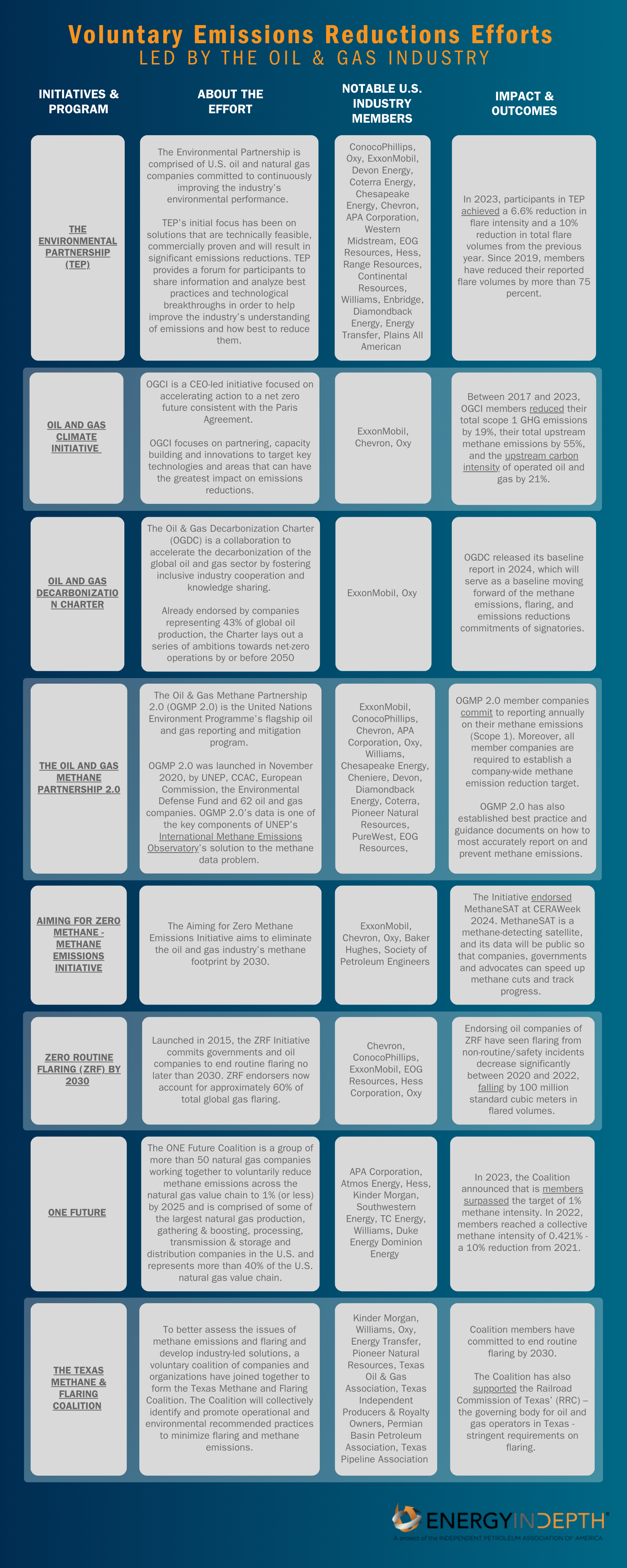
Voluntary emissions reductions efforts led by industry
American oil and gas companies in particular have been at the forefront of voluntary efforts and programs to reduce methane emissions – engaging at the state, federal and international levels.
Methane fee ignores industry progress and protests
Despite the clear and determined efforts that oil and gas companies have made to address their emissions – and the results to back up the success of those efforts – the Biden administration has moved forward with a new policy that could detract from successful emissions mitigation efforts.
During COP29 in Baku, Azerbaijan, the Biden administration announced that the U.S. Environmental Protection Agency had finalized its “methane fee”.
The new rule will require oil and gas producers to pay a fee for releasing excess methane emissions. The fee, mandated by the Inflation Reduction Act, requires violators to pay $900 per metric ton of excess methane emissions that are above the government threshold rolling up to $1,500 per metric ton starting in 2026.
The oil and gas industry has met the fee announcement with frustration – calling out the lack of industry input or collaboration in its development. Many oil and gas companies stated that they support emissions reduction policy – but the methane fee risks American energy security.
In response to the EPA’s announcement, the Independent Petroleum Association of America President and CEO Jeff Eshelman said:
“IPAA opposed the Waste Emissions Charge (Methane Tax or WEC) when it was being developed within the Inflation Reduction Act. The tax seriously complicates industry efforts to plan and comply with EPA and state regulations that address emissions from oil and natural gas production. The tax was passed without appropriate understanding of its impact or safeguards. It exemplifies the worst in legislation – no hearings, no committee reports, no conference report, no statements during floor debate. Now, EPA is using its regulatory authority to interpret the statute to consistently increase the taxable entities, to increase emissions calculations and to increase waste emissions thresholds while limiting the availability of the Exemption. IPAA maintains that EPA should reverse course, withdraw this proposal and the Subpart W proposal, and limit the adverse effects of the Methane Tax.” (emphasis added)
Likewise, the American Petroleum Institute told the Washington Post:
“API supports smart, effective methane regulations, yet this rule hampers our ability to meet the growing energy needs of American families and businesses and fails to advance meaningful emissions reduction. This is the wrong approach on methane policymaking, and we look forward to working with the incoming administration and new Congress to get this right.” (emphasis added)
In a March 2024 letter, sent before the fee was finalized, IPAA was joined by more than 20 oil and gas trade groups in voicing their concern to the EPA on the methane fee, writing:
“Reducing methane emissions is a shared priority for EPA and the oil and natural gas industry,” but went on to call out that “Rather than incentivizing emissions reductions, the proposed rule would maximize fees paid under the WEC and disincentivize accelerated emissions reductions.”
U.S. Senator Shelley Moore Capito (R-W.Va.) also highlighted the potential for the fee to hurt consumers and U.S. energy production:
“This natural gas tax will inflate prices for consumers and reduce domestic energy production, which will empower our adversaries abroad.”
Successful emissions policy must have the support of the oil and gas industry. With collaboration comes quicker adoption, enthusiasm and results. Instead, the EPA has pursued punitive methods and chosen to sunset successful voluntary and collaborative efforts with the oil and gas industry, like the EPA’s Methane Challenge Partnership and the Natural Gas STAR Partnership. The EPA has embraced the stick rather than the carrot.
This pivot ignores data showing the voluntary commitments and pledges to eliminate emissions can and does work.
In 2024, the International Energy Agency projected that if all methane pledges made by countries and companies are implemented and achieved in full and on time, it would cut methane emissions from fossil fuels by 50 percent by 2030. In its report, the IEA stated that voluntary initiative from the energy industry that collaborated with government would be critical to meeting emissions goals:
“When conducted in parallel with government action, industry initiatives play an important role in driving rapid cuts and leading abatement efforts.”
Bottom Line: The industry has leaned into reducing emissions and boosting efficiency. For better methane policy and a cleaner future, the incoming administration must seek to work with the oil and gas industry rather than against it.