Recently released Energy Information Administration data show that the Appalachian Basin’s prolific natural gas production – and the resulting switch to the fuel for electricity generation – is creating tremendous climate benefits.
Pennsylvania and Ohio held down the No. 1 and 3 spots for highest absolute decline of energy-related CO2 emissions from 1990 to 2018, according to the data. Additionally, West Virginia came in at No. 7 with 13.8 million metric tons (Mmt) of CO2 less in 2018 than in 1990 – a 13.3 percent reduction.
All told, the Appalachian Basin has seen CO2 emissions fall 93.5 Mmt or 15 percent since 1990, while natural gas production in the region grew nearly 2,000 percent.
#1 Pennsylvania
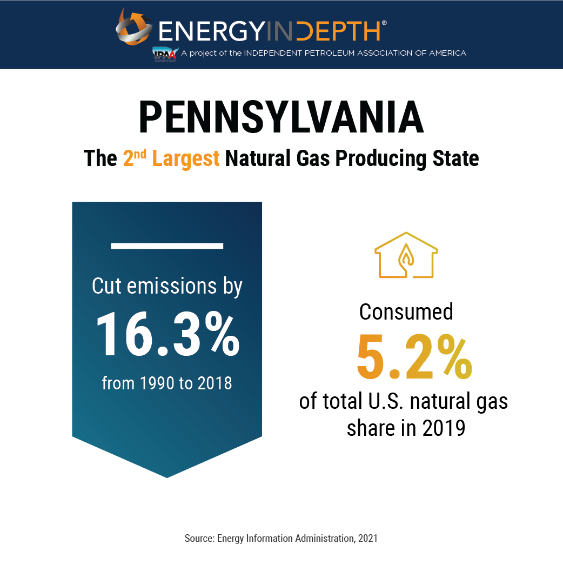
Pennsylvania is a natural gas giant, thanks to its position atop the Marcellus and Utica shales. As the nation’s second highest natural gas producing state, it produced nearly 7.3 trillion cubic feet (tcf) in 2020 – 5.7 percent more than in 2019 – and hasn’t shown signs of slowing down in 2021.
In 2019, the state also ranked among the five top natural gas-consuming states nationally, with a total consumption of 1.61 tcf or 5.2 percent of total U.S. share.
Pennsylvania’s electric power industry is increasingly fueled by natural gas, which made up 42.8 percent of the total electricity energy mix (98,040,344 MW/h) in 2019. Consumers also rely heavily on natural gas: More than 218 billion cubic feet (bcf) of natural gas was delivered to households, and an additional nearly 358 bcf to businesses and industries in 2020.
Alongside this prolific production and consumption, Pennsylvania reduced energy-related CO2 emissions by a whopping 42.4 Mmt (16 percent) from 1990 to 2018. As Pennsylvania Department of Environmental Protection Secretary Patrick McDonnell said during a state hearing in 2019:
“We were already well on our way in large part – and have actually since met what were proposed [Clean Power Plan] goals – primarily because of the shift toward cleaner natural gas.”
#3 Ohio

The Utica Shale formation has driven Ohio’s rapid increase in natural gas production on top of its emissions cuts in recent years. Ohio produced 15 times more natural gas in 2018 than in 1990 while simultaneously cutting CO2 emissions by 37.3 Mmt (15 percent).
In December 2020, electricity from natural gas came within 132 MW/h of surpassing electricity generated from coal and throughout the year more than 1 tcf was delivered to Ohio consumers. Out of Ohio’s 4.5 million households, 3.3 million residential customers (or 70 percent) depend on natural gas to heat their homes (70 percent) and 21 percent use it to generate hot water.
Northeast Also Seeing Benefits of An Abundant, Nearby Natural Gas Supply
Notably, it’s not just the states producing Marcellus and Utica shale gas that are seeing emissions drop because of it. Nearby New York and Massachusetts – despite policies that have created natural gas capacity issues – are major importers of natural gas and held down the No. 2 and 4 rankings, as a result.
#2 New York
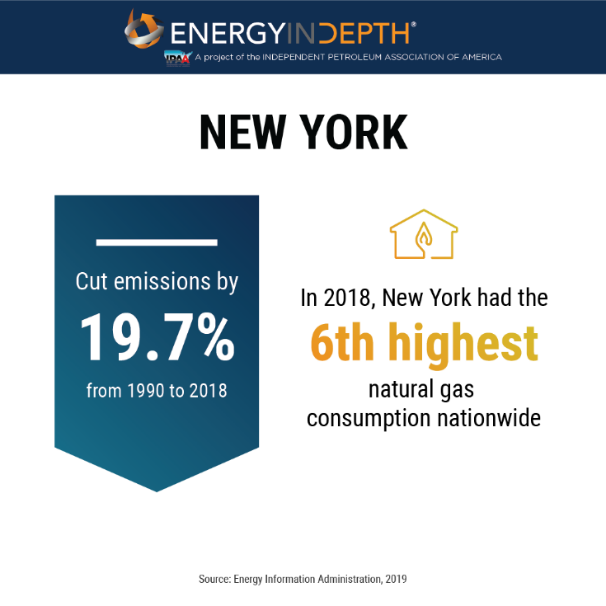
Some may find New York’s emissions reductions in recent years surprising – as the “city that never sleeps” has historically incurred high energy demand – but this state’s reliance on natural gas explains how these strides were even possible. It’s no wonder that the 6th highest natural gas consuming state nationwide in 2018 has cumulatively cut its emissions by 19.5 percent since 1990, according to the EIA. From 2018 to 2019, New York’s power sector even cut its carbon dioxide emissions from both conventional power plants and combined heat and power plants by 11.2 percent.
Natural gas contributes to emissions reduction outside of major emitting sectors. In 2020, 1.2 tcf of natural gas was delivered to New York consumers. Since New Yorkers often face harsh temperatures in winter, 3 in 5 New York households understandably turn to natural gas to heat their homes as a result.
#4 Massachusetts
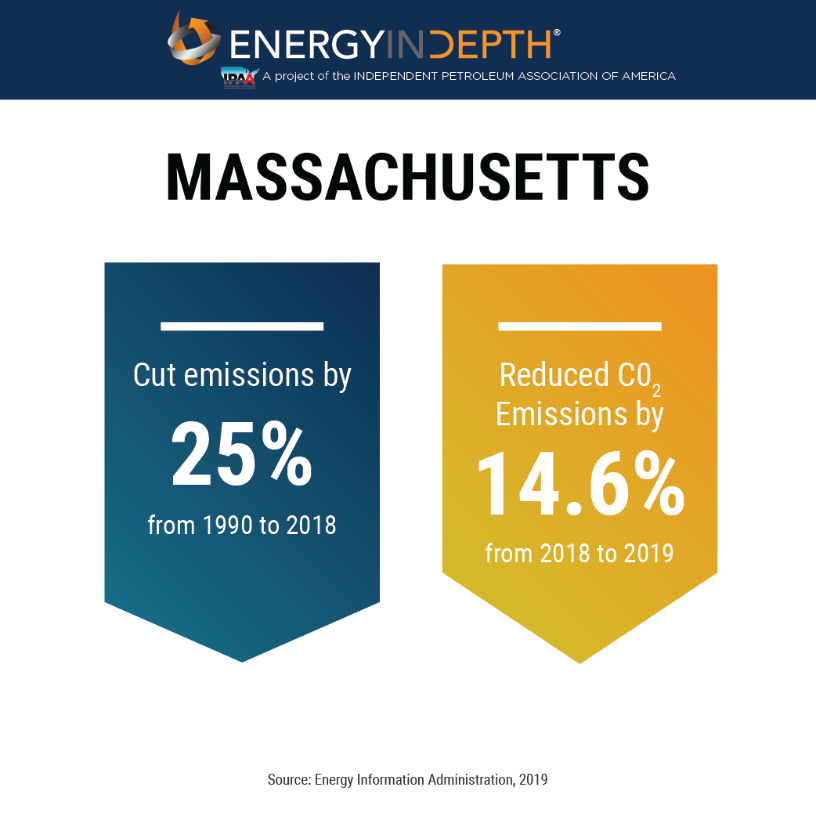
Over almost three decades (1990-2018), Massachusetts reduced emissions by 24.7 percent. Its emissions decline began around 2010, so it’s no surprise that the shale revolution has contributed to these reductions. During New England’s extreme winter months, more than half of Massachusetts homes use natural gas for heating. Natural gas has proven to be not only a mainstay for energy consumers looking for reliable, affordable power, but also a key instrument in mitigating climate change because of its lower emissions.
Conclusion
Just as it has become a major domestic energy source, the Appalachian Basin has also emerged as a game-changing source of significant emissions reductions in recent years. The position natural gas holds as a reliable and affordable resource is widely acknowledged, but the reductions in greenhouse gas emissions in populous states – and even gas-producing states, in the case of Pennsylvania and Ohio – further speaks to its central role in U.S. energy security. States with heavily industrial economies experience similar reductions in their environmental impact thanks to natural gas – a critical instrument in a well-rounded approach to mitigating climate change in coming years.