For the first time since the National Academies of Sciences temporarily removed a controversial climate science chapter, its new president is publicly addressing the controversy – and acknowledging that the chapters’ authors were closely “associated” with plaintiffs in climate lawsuits.
According to NAS President Neil H. Shubin, that imbalance gave people “good reason” to view the chapter as one-sided.
In late 2025, the Federal Judicial Center and the NAS co-published the Fourth Edition of the Reference Manual on Scientific Evidence. For the first time, the manual – which provides judges with best practices on understanding scientific research – included a chapter on climate science.
The chapter was authored by Jessica Wentz and Radley Horton and reviewed by Michael Burger. All three are affiliated with the Columbia University’s Sabin Center for Climate Change Law. Burger, in addition to being the Sabin Center’s executive director, also serves as Of Counsel to Sher Edling – the plaintiffs’ law firm representing numerous states and municipalities that have filed climate lawsuits.
Now Shubin is conceding that those affiliations mattered. During a recent podcast appearance, Shubin said:
“But we know the outcome was perceived — and for some, in good reason — as one-sided, because the authors were associated more with the plaintiff’s side than the defense side. That outcome deserves a fresh look.” (emphasis added)
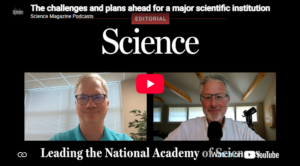
This is a major admission from NAS leadership – and blows a hole in efforts to dismiss concerns about the chapter’s neutrality as nothing more than partisan criticism.
NAS Says the Chapter Skipped Its Normal Review Process
Shubin also disclosed that the climate chapter did not go through the same process as formal NAS reports. He said:
“We looked at the process — just a very cursory look at the process behind this — and it turns out this was a book chapter that followed a very different process than the reports we do. The reports we do are — I hate to use the word ‘gold standard, but they’re our top-of-the-line sort of thing. They have numerous committees that weigh in on conflict of interest, committees that weigh in on peer review. There’s a strong level of oversight that seeks to produce the most impartial, nonpartisan, free of conflict of interest — or at least managing conflict of interest as best as possible. That’s the reports.”
Then he drew a stark contrast:
“A book chapter had none of that. So when we looked at that chapter, we realized there’s a lot we don’t know about the process behind it, but we know the outcome was perceived — and for some, in good reason because the authors were associated more with the plaintiff’s side than the defense side. That outcome deserves a new, fresh look.” (emphasis added)
That should raise serious questions. As Jason Isaac, CEO of the American Energy Institute stated:
“Accountability must go FAR beyond just a review. To rebuild trust, the NAS needs to examine how this happened, how to prevent it from happening again, and how to stop critical resources from being hijacked by activist propaganda.”
What Will the NAS Do Next?
The new details from Shubin are starkly different from the vague press release the NAS put out last month, which raises several questions:
Notably, Shubin has only served as NAS president for two months, assuming the position after the Reference Manual was developed and published. Former NAS president Marcia McNutt oversaw the Reference Manual’s publication.
Will The Plaintiffs and Activists Respond Now?
The people at the center of the controversy have largely avoided addressing these questions publicly:
In fact, Wentz and Horton have previously defended the climate science chapter but made no mention of Burger’s involvement or how an attorney representing plaintiffs in climate lawsuits does not pose a conflict of interest.
Bottom Line: The NAS president has released new information about their investigation into the Reference Manual’s climate science chapter, but it leaves more questions than it answered. Will the NAS provide further detail through official communications about the climate science chapter’s development.