For many reasons, 2020 has been a unique year. For the climate litigation campaign, EID Climate has covered major legal developments, delved into the funding sources behind these lawsuits and investigated the broader campaign pushing this baseless – and thus far unsuccessful – campaign against energy companies.
Although presented as a way to give power back to local governments and the people, it is important to remember that the activists and trial lawyers driving climate litigation campaign have much different goals – and may be motivated more by the potential for private gain than what’s in the public interest. At the end of the day, such lawsuits will simply raise prices for consumers, while doing nothing to actually solve climate change.
Here’s a look at the year in review:
Recruitment Campaign Continues
So far, the climate litigation campaign has been a dud. Every case that has been heard on its merits – Oakland and San Francisco, New York City and New York State – has been defeated in court. The California municipalities and NYC have nonetheless appealed those decisions and are in various stages of that process.
That track record of failure didn’t change in 2020.
Despite this lack of success, national activist groups and law firms – namely the Center for Climate Integrity and Sher Edling LLP – continued to recruit local officials for their losing cause. In municipalities and states across the country, these groups have doubled down on their campaign to bring more climate cases against energy companies, driven by their politically-motivated efforts to “delegitimize” the energy industry.
March
After announcing their lawsuit in November 2019, the City and County of Honolulu eventually filed legal action against energy producers in March of 2020. The case is currently stayed until the motion for remand – a request from the municipalities for the case to be moved from federal to state court – in the Maui case, which was filed in October 2020, has been fully briefed.
June
Minnesota Attorney General Keith Ellison sued a group of energy companies and a trade organization which represents the industry. The next day, Washington, D.C. Attorney General Karl Racine filed a very similar lawsuit against another group of energy companies. Even though Racine told reporters that he only learned of Minnesota’s lawsuit after it was filed, several sections within D.C.’s complaint are near – or complete – copy-and-paste jobs from Minnesota’s.
Both attorneys general have enlisted the services of Sher Edling to serve as outside counsel, although Minnesota, without explanation, took six months to publicly make that move. Likewise, each office is relying on the support of Michael Bloomberg-funded Special Assistant Attorneys General from the NYU Law Energy & Environmental Impact Center.
The defendants in both lawsuits removed the cases to federal court, after which the plaintiffs filed motions to remand them back to state court. The parties are currently litigating those motions; a hearing on Attorney General Ellison’s motion has been scheduled for January 13.
September
In September, the Cities of Hoboken, NJ and Charleston, SC, along with the Delaware and Connecticut attorneys general, all filed climate change lawsuits against energy companies within a two-week time frame. As is the case in several of the other lawsuits, the defendants have removed each case to federal court, though the plaintiffs are fighting to bring the cases back to state court. Notably, CCI’s parent organization, the Institute for Governance and Sustainable Development, is bankrolling at least the first several months of Hoboken’s suit while Sher Edling is on the scene in Charleston.
October
Represented by Sher Edling, the County of Maui filed a public nuisance lawsuit against major energy companies in Hawai’i state court, alleging their marketing, promotion and sale of fossil fuels worsened the impacts of climate change in their community. After the defendants removed the case to federal court, Maui is currently litigating its motion to remand the lawsuit back to state court, which should be fully briefed by January 20, 2021.
November
CCI and the Union of Concerned Scientists set their sights on Maine as a possible target for the next climate lawsuit, hosting a public webinar with local activists to discuss the climate litigation campaign. In the past, the two groups have highlighted the state in blogs, and even conducted polling on the issue in the state. Needless to say, they are trying to bring yet another state onto their floundering campaign.
Appellate Court Decisions
Phrase of 2020: Scope of Appellate Review
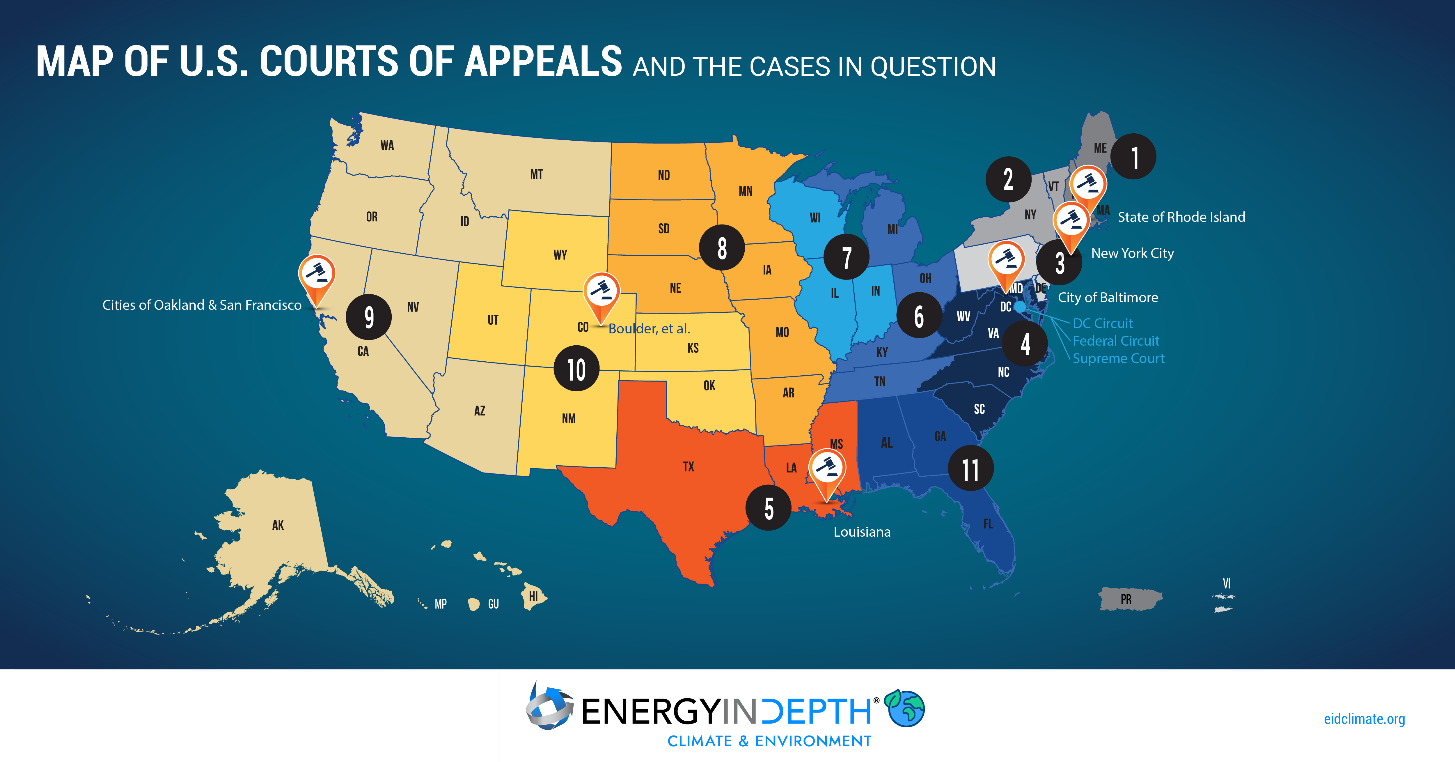
In March, the Fourth Circuit Court of Appeals affirmed a district court’s ruling and remanded the City of Baltimore’s public nuisance lawsuit to state court, after finding that it could review only one of the eight grounds for removal argued by the defendants: the question of federal officer removal statute. Since then, that perspective on the scope of appellate review has been echoed in the Ninth, Tenth and First Circuits, which remanded cases brought by California municipalities, Colorado municipalities and Rhode Island, respectively.
While the cases are currently stayed in state court, the energy companies have a chance to flip all the appellate court rulings. The U.S. Supreme Court announced in October that it is reviewing the issue after the defendants appealed the Fourth Circuit’s decision to remand Baltimore’s case; oral arguments will take place on January 19, 2021.
Although the Supreme Court’s review will focus on a nuanced procedural question, the decision will have massive ramifications for the entire climate litigation campaign. In fact, a ruling either way will reverberate throughout the country, directly impacting whether the dozens of pending climate lawsuits are heard in state or federal court, with the media acknowledging that if federal courts are the proper venue, then “it may make it harder for cities and states to secure victory in the climate cases.”
The jurisdictional question still remains before the Second Circuit, which is considering the fate of New York City’s public nuisance suit after it was dismissed in 2018.
The defendants also plan to appeal the other appellate court decisions to the Supreme Court in the new year. Already, they recently filed a petition for writ of certiorari contesting the Tenth Circuit’s decision, though have asked that the petition be stayed until proceedings in SCOTUS’ review of Baltimore have concluded.
Texas Court Criticizes “Lawfare”
This summer, the Second Court of Appeals in Fort Worth, TX reluctantly denied a petition filed by ExxonMobil that would have allowed it to conduct pre-suit discovery to examine an alleged conspiracy involving leading plaintiffs’ attorney Matt Pawa and the California municipalities suing the company for climate change impacts. Though the court ultimately dismissed the petition for lack of jurisdiction, the three-justice panel expressed reluctance in its opinion, acknowledging the merits of ExxonMobil’s claims and criticizing the municipalities for engaging in “lawfare” to pursue “environmental policy changes.”
ExxonMobil appealed the decision to the Texas Supreme Court in October. The defendants’ response to the company’s petition is due on February 3, 2021.
Oakland, SF Lawsuit Sent Back to Federal Court
In addition to allowing San Mateo, the County of Marin, City and County of Santa Cruz, City of Imperial Beach and City of Richmond – legally consolidated under San Mateo County – to proceed in state court, the Ninth Circuit Court of Appeals reversed the dismissal of Oakland and San Francisco’s lawsuits (which are also consolidated under Oakland). Finding that U.S. District Court Judge William Alsup erred in asserting federal jurisdiction, the appellate court resurrected the case and sent it back to Judge Alsup’s court to determine if there is “an alternative basis for jurisdiction.” The energy companies intend to file a petition for a writ of certiorari before the Supreme Court appealing the matter, which is due to the court by January 11, 2021.
Several cases are on hold pending the outcome of other legal decisions, including Oakland. The lawsuit brought by the Pacific Coast Federation of Fishermen’s Associations, for example, is stayed until the anticipated Supreme Court appeals in San Mateo County and Oakland’s lawsuits are resolved. King County’s lawsuit is also stayed pending the resolution of the petition for writ of certiorari in Oakland’s lawsuit or the Supreme Court decision in a related personal jurisdiction case (Ford Motor Co.).
U.S. EPA > The Courts
The Conservation Law Foundation is fighting to overturn a Massachusetts district court’s decision to stay its lawsuit against ExxonMobil, which alleges that the company failed to adequately safeguard its Everett, MA oil storage facility against the impacts of climate change. A judge halted the case in March, saying that the U.S. Environmental Protection Agency , not the courts, is the proper authority to decide issues of science and policy as they relate to climate change.
The case is paused until the EPA has a chance to review a since-expired Clean Water Act permit for the facility or until November 2021, if a new permit has not been issued by then. CLF, however, is fighting to overturn that ruling and appealed the district court’s decision to the First Circuit earlier this year. A three-judge panel heard oral arguments on the matter in December, where, as Law360’s Chris Villani reports, CLF’s argument was “met with skepticism.”
Massachusetts Continues to Falter
The Massachusetts attorney general’s case was already facing an uphill battle after New York’s comprehensive loss last year. Now, ExxonMobil has filed two motions , seeking to dismiss the lawsuit for its flagrant constitutional violations and failure to state a claim in support of the consumer and investor deception allegations. These filings came after the attorney general filed an amended complaint in June that dropped one of the two claims of investor deception – a theory that was largely copied and pasted from the New York attorney general’s securities fraud lawsuit that failed after a less than three-week long trial in November 2019. The court is expected to schedule oral arguments on ExxonMobil’s filings in the new year.
Looking Ahead
President-elect Joe Biden’s arrival in the White House could have major implications for the climate litigation campaign, as he has vowed to “strategically support” these lawsuits as president and is already under pressure from environmental activist groups to make good on that pledge. However, a lack of concrete ideas and statutory hurdles – combined with the fact that many activist groups have had a hot-and-cold relationship with Biden – means there is still a great deal of uncertainty regarding how the next administration will approach these climate lawsuits.
Nevertheless, although framed as being in the public’s interest, the localized climate liability litigation is simply another tool used by a coordinated network of activists and deep-pocketed donors. The courts cannot offer the solutions that states, and its citizens, need to address climate change – a reality that hopefully elected officials will recognize in the new year.