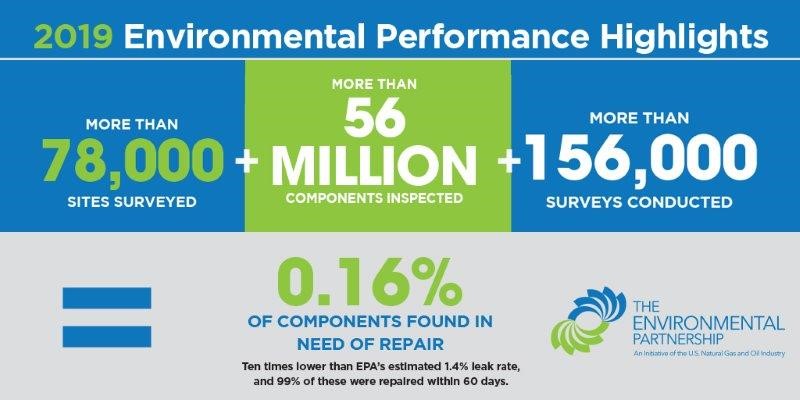
The U.S. oil and natural gas industry is working together to reduce emissions, and these efforts by many of the nation’s leading energy companies are seeing significant results. In fact, companies voluntarily participating in the Environmental Partnership found methane leakage rates across their operations to be only 0.16 percent – 10 times lower than U.S. Environmental Protection Agency estimates, according to the group’s annual report.
The 65 energy companies participating in the Environmental Partnership aren’t just identifying issues; they’re fixing them: 99 percent of methane leaks were detected and repaired within 60 days.
Thanks to leadership and innovations by the oil and natural gas industry, the United States is leading the world in both reducing emissions and oil and natural gas production. Reducing methane emissions has been a focal point of the industry for decades, and even more so in recent years. As Mike Somers, CEO and President of the American Petroleum Institute explained:
“Our industry is taking action to reduce methane emissions from our operations. Through innovative and action-oriented partnerships like this one, we will continue to take action to protect our environment and safely produce and deliver the energy consumers demand. The Environmental Partnership places technological innovation, collaboration with academia, engineers and manufacturers, and industry action at the heart of its mission and we’re proud of its tremendous progress and activity in its first year.”
Companies Focus on Most Common Sources for Leaks
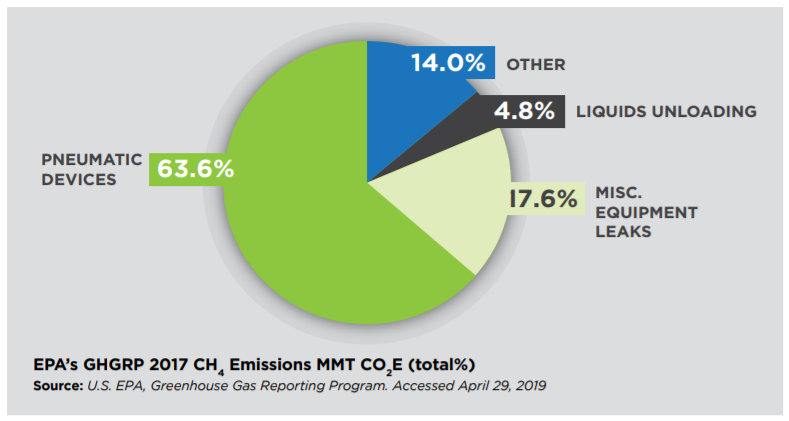
The Environmental Partnership, which represents more than 80 percent of the top natural gas producers in the country, has focused its efforts on the three primary sources of industry emissions, as detailed by the EPA’s Greenhouse Gas Reporting Program: pneumatic devices, equipment leaks, and leaks that occur during the liquids unloading process.
Since 2017, the Partnership has replaced over 31,000 high bleed pneumatic controllers, inspected more than 56 million components, and monitored more than 132,000 manual liquid unloading events to reduce emissions.
The results of continued innovation and dedication by industry to produce energy cleaner and more efficient than ever are staggering. In the Permian Basin, energy production grew 100 percent from 2011 to 2017, while methane emissions relative to production fell nearly 40 percent, according to the report. Meanwhile, production grew 130 percent in the Eagle Ford Basin over the same time period, while methane emissions fell by nearly 70 percent.
Voluntary Collaboration, Not Regulation Spurs Innovation
Collaboration and information sharing are the key to the successful and significant reduction of energy-related emissions, according to the Environmental Partnership. Fostering a culture that enables the industry to better share best practices is an important component to this, as API’s Mark Green recently described:
“[I]t was remarkable to see representatives of a major natural gas-producing company share what they had learned about controlling emissions from storage tanks. It was a conversation, not a lecture. Questions were asked and answered. There was give and take on highly technical topics such as flash factors and compressor dumps. The great thing was the spirit of cooperation among all the participants, irrespective of their company’s name or size.”
While there isn’t a one-size fits all approach to reducing these emissions, these collaborations are enabling companies of all sizes to find the solutions that work best for their operations.
Conclusion
The Environmental Partnership is just one important way that the U.S. oil and natural gas industry is reducing its environmental footprint, while continuing to supply the country and the world with these important resources. As the report described:
“Answering the dual challenge of meeting the world’s growing energy needs while powering innovation to continuously improve America’s environmental performance has never been more important, and we’re committed to leading the way and doing our part.”