New York’s aggressive climate policies are colliding with a harsh reality: the cost to consumers.
Case in point: the Climate Leadership and Community Protection Act signed into law by then-Governor Andrew Cuomo in 2019. The sweeping climate law requires significant reductions in greenhouse gas emissions, full net-zero by 2050, and mandates 70 percent of the Empire State’s electricity come from renewables by 2030.
While environmental activists hailed it as landmark climate legislation, it’s been making headlines recently because passing the bill proved a lot easier than implementing it. Governor Kathy Hochul, who was Cuomo’s lieutenant governor when the bill was signed, is claiming “there were so many unforeseen factors” and only now acknowledging “there’s going to be enormous costs” for consumers if the state is forced to enforce the law. In fact, a recent state-issued memo found that New York City households using natural gas could face $2,300 in additional costs annually under the law.
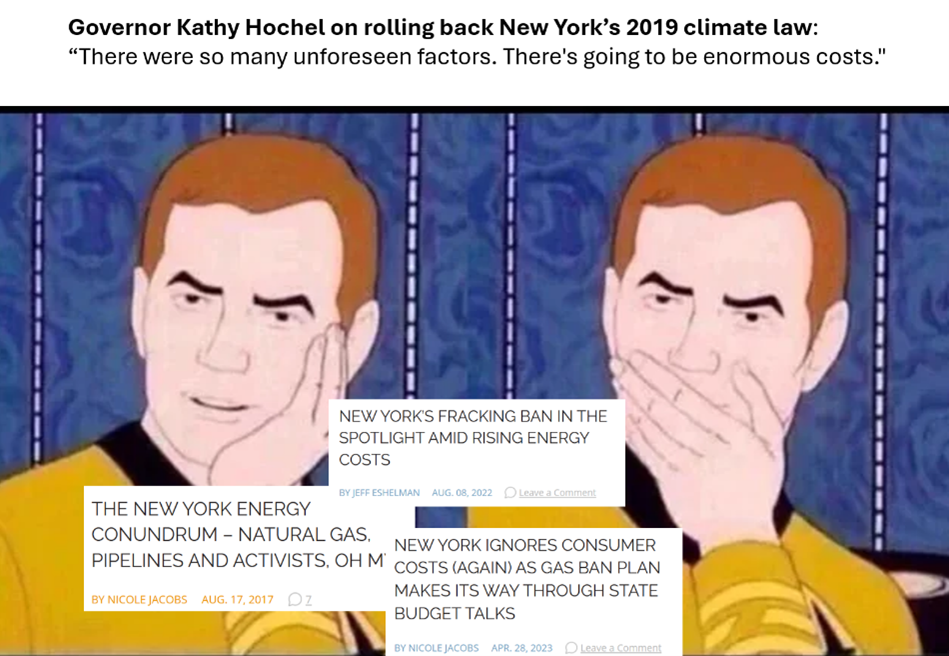
But the sudden concern for constituents’ wallets is uncannily reminiscent of the Cuomo administration blocking every natural gas pipeline deemed critical to meet growing demand and then turning around and threatening to revoke licenses when utilities were forced to issue moratoriums on new hook-ups because they didn’t have access to enough natural gas to add new customers.
Unlike her former boss, Gov. Hochul appears to understand that in order to change the outcome, you have to address the problem head-on and has confirmed she wants to rewrite the law. Because as she explained in recent comments, in order to meet the goals within the timeline currently set by the legislature:
“There’s going to be enormous costs to families.”
This moment where misguided policy meets a reality where consumers face skyrocketing prices didn’t happen overnight though. It’s been building for more than a decade and continues even with bills introduced in the current legislative session.
A History of Anti-Industry Attacks
New York is right up there with California as an excellent example of what happens after years of attacking the energy industry.
The Empire State once proudly boasted about being home to the first commercially viable natural gas well drilled in Fredonia in 1821 – also the birthplace of the first American natural gas distribution company, Fredonia Gas Light Company – and produced just shy of 56 billion cubic feet (bcf) of natural gas at its peak of production in 2006.
Today, the state produces a fraction of that (approximately 9 bcf in 2024) despite “natural gas-fired power plants account[ing] for over half of New York’s generating capacity and provid[ing] 47 percent of the state’s electricity net generation, generating more than twice as much electricity as any other fuel source,” according to the Energy Information Administration.
How did we get here?
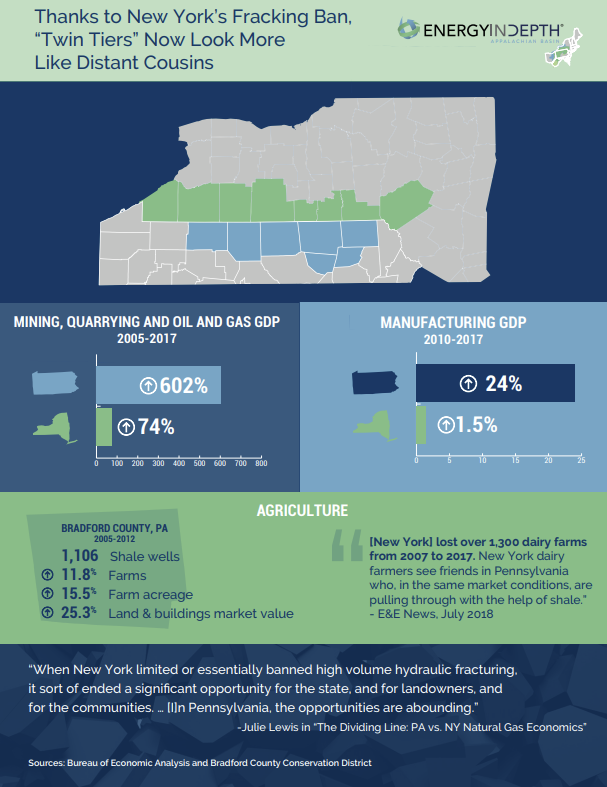
When the Shale Revolution kicked off in the early 2000s, New York was viewed as a state with a lot of opportunities to grow its natural gas production. But unlike neighboring Pennsylvania, New York threw on the brakes and ultimately banned high volume hydraulic fracturing in 2014. The ban demonstrated that New York was closed for business for oil and gas production, and the Cuomo administration, as well as other leaders in the state, spent the next decade plus solidifying this position.
This included then-Attorney General Eric Schneiderman filing a subpoena in 2015 that launched the legal crusade against American energy companies. Throughout the next few years, the administration blocked key pipeline infrastructure projects despite growing natural gas demand and vocal concerns over limited capacity.
Then, New York City sued five companies in January of 2018 for allegedly causing Hurricane Sandy and, after that case was thrown out in 2021, refiled another lawsuit, which was once again dismissed, meeting the same fate as the attorney general’s defeat in 2019.
In 2019, Gov. Cuomo signed the aforementioned climate law that led to him announcing his plans to ban natural gas in buildings in 2023. In 2024, the legislature passed the Climate Superfund Act – forcing the domestic energy sector to pay for alleged climate damages – and just last month introduced a bill that would criminalize corporate executives for allegedly causing climate and environmental disasters. The bill leaves no room for interpretation: New York lawmakers want to punish the oil and gas industry from every angle possible.
Superfund laws pose as a way to help with consumers costs, but in reality, they do the opposite. As Jeff Kupfer, president of ConservAmerica, explains:
“Large, predictable compliance costs do not just stay on balance sheets. Families and businesses inevitably pay the price. The billions of dollars in costs ripple outward, raising prices for households, manufacturers, farmers, truckers, and anyone who relies on affordable and reliable energy.”
None of these laws address the extremely high energy costs in New York, and the dangers of this type of legislation are well understood. More than 20 state attorneys general, industry trade associations, and even the U.S. DOJ sued New York because of the superfund program. As West Virginia AG McCuskey explained:
“This bill is an attempt by New York to step into the shoes of the federal government to regulate something that they have absolutely no business regulating.”
As Energy in Depth has previously analyzed, the state’s focus on climate goals and attacks on natural gas have forced consumer cost concerns to the backburner. It’s all catching up to New York. Now, it ranks among the 10 most expensive states for electricity costs, piling on top of its sky-high housing costs. With an affordability crisis plaguing citizens, it’s no wonder the 2019 climate law is back in discussion.
Hochul Turns a New Leaf as Costs Surge
Gov. Hochul’s assessment of the 2019 climate law is one focused on affordability, and for good reason. Although she has yet to make a formal proposal, she has made it clear she wishes to amend the law. As Gov. Hochul emphasized in recent comments:
“Back in 2019, there were very ambitious goals, important goals, worthy goals to do what we can in the state of New York to deal with the climate crisis which we’re feeling the effects of now. But there were so many unforeseen factors…there’s going to be enormous costs.”
Well, the industry certainly saw these unforeseen circumstances the governor – and her predecessors – purposefully ignored. As Energy in Depth has previously analyzed, affordability and energy have always been interconnected, but warnings about the negative impacts of these aggressive mandates have historically been ignored. Former Lieutenant Governor of New York and the current President of the Greater Rochester Chamber of Commerce, Bob Duffy, was clear about how the law will impact New Yorkers:
“The timelines have to change. They lack common sense. They’re hurting people’s pocketbooks.”
Even the state’s powerful labor unions, are now backing changes to the law, citing “affordability an reliability [as] serious concerns.”
In a state like New York, where natural gas heats nearly half the state’s homes and generates nearly half of its electricity, attacking oil and gas companies is clearly the wrong choice. As The New York Times reports:
“Ms. Hochul’s camp, which includes some moderate Democrats, argues that penalizing polluters through the climate law will drive up oil and gas prices when too many New Yorkers remain dependent on fossil fuels for electricity, heating and cooking.”
Still, Gov. Hochul’s change of tune on climate policy is in sharp contrast to her record of anti-energy decisions, including denying permits to gas plants and advocating for aggressive natural gas bans. And, to be fair, she isn’t the only Democratic state leader backing away from aggressive climate policy in the face of high energy prices.
New York is indeed not alone. Massachusetts recently delayed implementation of its proposed Clean Heat Standard until at least 2028 after concerns that it would raise heating costs for residents.
Now, New York legislators and Gov. Hochul are facing a similar dilemma: delay or amend overly ambitious climate mandates or continue to ignore consumers’ cost concerns. Ken Girardin, a fellow at the Manhattan Institute, painted a scary reality if efforts fail and the law goes into effect:
“The law remains on the books, and its defenders balk at revision. If Hochul can’t persuade them to change it, Albany’s green dreams will cause harsh conditions in the Empire State — steep electric bills, green-energy boondoggles and rolling blackouts.”
Bottom Line: New York’s current situation is a case study of what happens when affordability is ignored for years, and politically-driven climate mandates are prioritized over real-life energy needs. Only time will tell if Gov. Hochul and the state’s lawmakers are prepared to spare residents from another move that will only raise costs.